Open source / repository archive

代码留下来的, 不只是代码。

这里整理我公开的仓库:从 README 的第一句话,到语言比例与项目骨架,让每个项目在打开代码之前先被理解。

11 个仓库 16 种语言 10 颗 stars 同步于 2026-10-09 09:07
GitHub 主页
01 PUBLIC / GITHUB ↗

Swift / 2026年10月

LingXiAgent

Live

An all-in-one Agent that can connect to major providers, delivering a complete and elegant user experience

★ 1 ⑂ 0 Other 2026年10月
  • #agent
  • #agents
  • #ai
  • #ai-agent
  • #lingxifox
LANGUAGE MIX 8 languages
  • Swift93.4%
  • HTML3.0%
  • Shell1.5%
  • JavaScript1.1%
  • CSS0.4%
  • PowerShell0.3%
  • Python0.2%
  • C0.1%
FILE TREE / TOP LEVEL 28 entries
├── ▾ .dev-sandbox-backups/
├── ▾ .github/
├── ▾ Apps/
├── ▾ ContractTests/
├── ▾ Docs/
├── ▾ Evals/
├── ▾ LingXiAgent Icon/
├── ▾ OpenTUISwiftPoC/
├── ▾ Plugins/
├── ▾ Scripts/
├── ▾ SDKs/
├── ▾ Server/
├── ▾ Sidecars/
├── ▾ Sources/
├── ▾ Tests/
├── ▾ Vendor/
├── .env.example
├── .gitattributes
├── .gitignore
├── .swift-version
├── install.ps1
├── install.sh
├── LICENSE
├── LICENSE-CORE
├── LICENSE-FRONTEND
├── LICENSE-MATRIX.md
├── Package.swift
└── README.md
README README.md

LingXiAgent

🦊
Native Swift AI Coding Agent with Heterogeneous Dual-Core Architecture
新一代纯 Swift 原生打造的终端 AI 编程智能体 · macOS / Linux 官方支持 (CLI + TUI + WebUI) · Windows 实验性支持


Website Docs Models Release License


[!IMPORTANT] 平台支持口径 (Platform Support Matrix) — 正式 release 版本以 GitHub Releases 为准,产品版本常量在 Sources/LingXiProtocol/ProductVersion.swift

操作系统 支持级别 交付形态 预编译发布包 (Prebuilt) 源码构建 (Source Build) 平台专属能力边界说明
macOS Supported (release blocker) CLI + TUI arm64 (Apple Silicon) Apple Silicon / Intel 全功能就绪:Seatbelt 原生沙箱、Browser Use、视觉桌面感知 (Computer Use)
Linux Supported (release blocker) CLI + TUI x86_64 (Ubuntu/Debian/Arch) x86_64 / AArch64 核心就绪:Bubblewrap 沙箱、Browser Use;桌面视觉 Computer Use 暂不开放
Windows Supported (x86_64 预编译包已发布) CLI + TUI x86_64 (lingxiagent-windows-x86_64.zip) x86_64 / ARM64(ARM64 仅源码路径) Win32 抽象完整:VT100 控制台、%PATHEXT%、taskkill /T 进程树;sqlite3.dll 随包发布。桌面视觉能力按宿主实际可用性如实申报

表现层由纯受控客户端 LingXiTUI 驱动,系统底层由独立平台层 LingXiPlatform 与 CSQLite 提供跨平台强一致保障。 历史遗留问题与复现路径记录在 Docs/V1-Cross-Platform-Baseline-Audit.md 的 V1.1.0 交接章节。


⚡ 快速安装与上手 (Quick Install)

macOS / Linux (一键安装)

在终端中执行官方一键安装器(自动检测系统架构、配置环境并部署二进制):

curl -fsSL https://agent.lingxifox.cn/install.sh | bash

[!NOTE]

  • 预编译与架构:macOS 预编译发布包针对 Apple Silicon (arm64),Linux 预编译发布包针对 x86_64。Intel Mac (x86_64) 或 AArch64 Linux 运行安装脚本时,若系统已安装 Swift,将自动浅克隆极速源码编译安装。
  • 安装产物:安装器将自动部署三个可执行入口与配套资源:
    • lingxiagent:主程序入口(交互式 TUI、CLI 子命令、ACP 守护进程);
    • LingXiTUI:独立终端 TUI 视图入口;
    • LingXiCoreHost:内核服务宿主(支持 Stdio IPC 通信);
    • LingXiAgent_LingXiCore.bundle 与 Sidecars(Browser 自动化等扩展能力)。
  • 推荐系统依赖:grep 与 glob 工具在运行时依赖系统的 ripgrep (rg)。推荐提前安装:
    • macOS: brew install ripgrep
    • Linux (Ubuntu/Debian): sudo apt install ripgrep
    • Linux (Arch): sudo pacman -S ripgrep

Windows (x86_64 预编译包已发布)

自 v1.1.0 起 Windows 有正式预编译包:lingxiagent-windows-x86_64.zip(附同名 .sha256), 解压后直接运行,sqlite3.dll 与资源包已随包放在同一目录。官方安装器:

irm https://agent.lingxifox.cn/install.ps1 | iex

ARM64 Windows 与其余非 x86_64 架构走源码构建(需本机 Swift 工具链):

swift build -c release --product lingxiagent
swift build -c release --product LingXiCoreHost
swift build -c release --product LingXiTUI
swift build -c release --product lingxiagent-ops

安装完成后,新开终端直接输入 lingxiagent 开启会话。完整使用手册与高级配置见 LingXiAgent 官方技术文档;插件开发见 LingXiPluginSDK 文档。


🌟 核心特性概览

  • ⚡ 原生编译,无脚本运行时:全系统基于 Swift 6 现代并发(Concurrency & Actors)构建,交付的是原生二进制,不依赖 Node.js / Bun / Electron 运行时。启动耗时与常驻内存随终端模拟器与宿主环境变化,本项目不发布未经复现的 benchmark 数字。
  • 🧠 P-Core / E-Core 上下文双核分工:
    • P-Core(Prompt-resident reasoning context,PCoreContextEngine):决定什么留在模型请求的上下文里——稳定前缀、递增上下文与 E-Core 索引投影;淘汰由 P 侧保留策略决定,并配合上游 Prompt Cache;
    • E-Core(Context object store / recall,ECoreObjectStore):保存被 page-out 的完整对象,提供引用索引、按 ContextObjectID 精确还原与语义召回。工具输出超过 context.fabric.objectizationThreshold(默认 32,768 字节)即对象化,P-Core 只持有引用与摘要。
  • 🖥️ 表现层与核心彻底解耦 (Frontend 契约):
    • TUI 全面降维为纯受控客户端,遵循 @MainActor Frontend 协议,不私自启动或管理核心;
    • 核心生命周期、Stdio IPC 与 Store 装配统一由 AppCompositionRoot 统一接管,CLI / TUI / WebUI 三个正式前端共用同一套契约,GUI 与远端 RPC 沿用同一入口。
  • 🛡️ 宿主感知的客户端请求画像(ClientFingerprint):
    • 按渠道动态生成出站 User-Agent 与伴随请求头,其中操作系统与架构字段取自真实宿主(ClientFingerprint.currentPlatform()),不硬编码其它平台的字符串;
    • 只影响应用层 HTTP 头部:它不改变传输层 TLS/TCP 栈,因此不存在也不宣称「TLS/JA3/JA4 指纹伪装」,更不承诺任何「绕过风控」的效果——上游如何判定由其自身策略决定。
  • 🔑 官方订阅与通用 API 物理隔离双轨制:
    • 支持 ChatGPT Plus/Pro (Codex OAuth)、Claude Code 官方订阅免 API 费用直连;
    • 通用模型清单以 Models Hub 发布的 models.json 为准(Provider 与模型数量随上游变化,仓库与文档不写死计数);实际可选用哪些还取决于本机运行时契约与账号可用性。
  • 🔌 全功能 MCP (Model Context Protocol) 运行时与 Skills 体系:
    • 原生支持 stdio 与现代 streamableHTTP 双通道;
    • 内置 RFC 9728 & RFC 8414 OAuth 2.1 浏览器本地回送授权;
    • 工具 Schema 分页拉取与短租约(Lease)调度;兼容标准 SKILL.md 技能动态注入。
  • ⏳ 后台命令异步执行与模型休眠唤醒 (Background Tasks):
    • 内置原生 run_background_command 与 manage_background_command 工具及 /tasks 管理命令;
    • 模型派发后台命令后自动进入休眠挂起,绝不消耗空转 Token;任务完成、超时或异常时自动唤醒模型读取日志完成收尾汇报。
  • 🛑 Esc 全局无死角熔断中断:
    • 按下 Esc 键立即熔断一切活动状态(包含正在思考中的模型、休眠挂起中的任务、活跃的前台工具调用);
    • 深度级联向后台所有子进程树发送强杀信号(SIGKILL / taskkill),彻底清空一切空转残留。
  • ⌨️ 现代终端编辑与历史健壮水合:
    • 输入框支持 Left / Right / Home / End / Up / Down 字符级精准光标导航;
    • 支持 /new 快速新建会话与跨工作区 /resume 断点续存,具备历史消息就地去重与空时间线兜底水合能力。
  • 🤝 开放编辑器标准协议支持 (ACP - Agent Client Protocol):
    • 原生实现标准 ACP 协议(JSON-RPC 2.0 over Stdio),支持 initialize、session/new、session/load、session/prompt 与 session/cancel;
    • 可直接作为 Agent 后端接入 Zed IDE、JetBrains 与 Neovim 等现代编辑器,后台双向流式转送文本增量、思考流与工具交互。
  • 🔍 多语言 LSP 代码智能语义矩阵 (Language Server Protocol):
    • 内置跨平台语言服务器编排器(LSPCoordinator),涵盖 Swift (sourcekit-lsp)、Python (pyright/pylsp)、TypeScript/JavaScript (vtsls/typescript-language-server)、Rust (rust-analyzer)、Go (gopls)、C/C++ (clangd);
    • 为 Agent 提供 definitions、references、document_symbols、diagnostics、hover、completion 六大精确代码语义能力;
    • 具备实时文件同步与环境平滑降级(LSP 未安装或崩溃时安全回退至正则与 Index 引擎),保障 Agent 稳定可靠。
  • ⚡ 多语言代码格式化引擎 (Code Formatter - 对标 OpenCode 规范):
    • 内置 format_file 工具与写盘后置自动格式化(Auto-format on save),写完代码自动保持排版美观;
    • 自动感知项目本地及全局环境:Swift (swift-format)、Python (ruff/black)、TypeScript/JavaScript/Web (prettier/biome)、Rust (rustfmt)、Go (gofmt)、C/C++ (clang-format);
    • 具备 15 秒超时看门狗与静默平滑降级,格式化器未就绪或报错绝不阻断 Agent 生成流程。
  • 🗺️ 原生代码图谱与拓扑分析引擎 (Codebase Knowledge Graph - 对标 codebase-memory):
    • 内置轻量有向图模型与 AST 拓扑提取器(codebase_graph 工具),实现零外部重型依赖的本地代码认知图谱;
    • 支持 architecture:自动提取高层架构分层(api / core / infra / test)、模块依赖拓扑及核心高扇入热点符号(Hotspots);
    • 支持 trace:沿着 calls 关系进行双向 BFS 拓扑遍历(inbound 追查调用方,outbound 追查被调用方,支持 1-5 级深度追溯);
    • 支持 search 拓扑符号检索与增量时间戳轻量本地持久化缓存。
  • 🔒 本地加密凭据保险箱:
    • 凭据统一存放在数据目录的 credentials.vault:AES-256-GCM 认证加密,密钥来自口令派生(PBKDF2-HMAC-SHA256,≥100,000 轮)或机器绑定的保护性密钥,文件权限收紧到 0600;macOS Keychain 只做一次性迁移读取;
    • 配置文件里不允许出现明文凭据:providers.json / mcp.json 的凭据字段只接受 {env:VAR} 与 {vault:...} 引用形式;{vault:...} 是唯一的持久凭据源,{env:VAR} 只作开发 / CI / 命令行临时覆盖用(Dock/Finder 启动的 GUI 继承 launchd 环境,读不到登录 shell 的变量),LINGXI_<PROVIDER_ID>_API_KEY 是显式覆盖层,优先级最高;
  • 🎨 现代交互式 TUI 体系与 24-bit TrueColor 主题引擎:
    • 内置 6 套高保真配色主题(LingXiAgent Dark、LingXiAgent Light、Catppuccin Mocha、Nord Aurora、Dracula、Monochrome Minimal),支持 24-bit RGB TrueColor 与 ANSI 动态回退;
    • 全局快捷键 Ctrl+T 或 /theme 呼出弹出式主题选择器 (Theme Picker),支持按键即时搜索过滤、光标上下切换与免重启即时热重载;
    • 交互操作全面浮层化 (Interactive Pickers):/mode (Build/Plan/Explore 模式直选)、/permissions (Ask/Auto/YOLO 权限策略直选)、/reasoning (Auto/Off/Low/Medium/High/Max 思考等级直选) 均支持方向键直选即生效,告别手打二级参数;
    • 大篇幅查阅全面模态化 (Modal Overlays):快捷键速查 (/keybindings)、代码变更审查 (/diff)、技能库清单 (/skills)、系统仪表盘 (/status)、双核上下文 (/context)、性能报表 (/perf)、MCP 监视器 (/mcp) 均收敛至居中浮动模态卡片,支持 j/k/上下平滑滚动与 Esc 退出,彻底告别终端滚屏刷屏与对话流污染。
  • 🖥️ 浏览器与操作系统级视觉桌面感知 (Browser & Computer Use):
    • 内置高精度双显示器视觉捕获与屏幕坐标计算(computer_batch),支持 0 误差动态租借工具调度;
    • 原生支持无头与有头真实浏览器会话控制,实现端到端自动化。

🏛️ 系统架构设计 (Architecture Blueprint)

flowchart TD
    subgraph UI_Layer["🖥️ 表现层与客户端 (Frontend Layer - Fully Decoupled)"]
        TUI["LingXiTUI (OpenTUI C ABI / ANSI 回退)"]
        CLI["lingxiagent CLI (统一运维与无头执行)"]
        WebClient["LingXiWebUI (lingxiagent serve · 快照 + 增量 SSE)"]
    end

    subgraph Bootstrap_Layer["🚀 装配与生命周期层 (Bootstrap)"]
        Root["AppCompositionRoot (统一装配根)"]
        Store["ApplicationStore (单向数据流状态机)"]
    end

    subgraph Platform_Layer["🌐 跨平台系统底座 (LingXiPlatform)"]
        PlatformFacade["LingXiPlatform.current (统一门面)"]
        DarwinAdapter["Darwin Adapter (macOS / Seatbelt)"]
        LinuxAdapter["Linux Adapter (Bubblewrap bwrap)"]
        WindowsAdapter["Windows Adapter (Win32 Console VT100 / taskkill)"]
    end

    subgraph Core_Engines["🧠 异构双核业务引擎 (LingXiCore)"]
        subgraph P_Core["🔥 P-Core: 驻留在模型请求中的推理上下文"]
            ReasoningLoop["Agent Decision & Tool Loop"]
            StablePrefix["Stable Prefix(稳定前缀 · 命中 Prompt Cache)"]
            GrowingCtx["Growing Context(本轮增量与工具轨迹)"]
            IndexProj["E-Core Index Projection(只投影引用与摘要)"]
        end

        subgraph E_Core["⚡ E-Core: 上下文对象存储与召回"]
            ToolRuntime["Tool Engine & Sandbox Watchdog"]
            ObjectStore["ECoreObjectStore(完整对象 · 精确还原 · 语义召回)"]
            StateDB["SQLite Store (catalog.sqlite / state.sqlite)"]
        end

        MCPRuntime["MCP 运行时 (stdio / streamableHTTP / OAuth 2.1)"]
        ModelGateway["多协议模型网关 (Codex / Claude / Universal API)"]
    end

    subgraph Persistence["🔒 安全存储与持久化"]
        Vault["PlatformSecureCredentialStore (AES-256-GCM 本地加密保险箱)"]
        ConfigJSON["JSON Configuration (config / providers / mcp)"]
    end

    UI_Layer --> Bootstrap_Layer
    Bootstrap_Layer --> Platform_Layer
    Bootstrap_Layer --> Core_Engines
    Core_Engines --> Platform_Layer
    Core_Engines --> Persistence
    P_Core <== "语义证据引用 / 旁路隔离总线" ==> E_Core

Swift Package 模块职责定位

Target 职责定位 核心依赖
LingXiProtocol 纯强类型契约层,定义领域实体、流式帧(Wire Frame)、错误码与 RPC 协议 纯原生,零外部依赖
LingXiPlatform 跨平台系统调用抽象层(Darwin/Linux/Windows 原生适配、沙箱、进程树级联灭活) 纯原生系统接口
LingXiCore 业务权威中心,内含 P-Core 推理总线、E-Core 旁路对象池、Tool/MCP/Provider 引擎 LingXiProtocol, LingXiPlatform
LingXiClient 驱动 Core 的双工客户端 SDK,支持进程内通道及 Stdio JSON Lines 管道通信 LingXiProtocol, LingXiPlatform
LingXiApplication 应用层业务聚合与表现层契约,定义 Frontend 协议与 AppCompositionRoot LingXiClient, LingXiProtocol, LingXiPlatform
LingXiTUI 纯表现层受控终端,遵循 Frontend 契约,支持双栏渲染与富文本流式交互 LingXiApplication, LingXiTUIComponents, LingXiPlatform
LingXiCoreHost 独立 Core 后台服务执行体,提供标准 Stdio JSON Lines 协议管道 LingXiCore, LingXiProtocol, LingXiPlatform
lingxiagent 用户前端入口:无参数进入 TUI,serve 起 WebUI 整合各层入口
lingxiagent-ops 运维与批处理入口:auth / models / mcp / skills / exec / review / doctor / resume / acp / task / completion(lingxiagent 遇这些动词只转介到这里) 链接 Core 做后端管理

此外两个独立仓库、独立 MIT、独立 SemVer 的公共 Swift Package 不属于本仓库的 target:LingXiModelSDK(模型目录消费者)与 LingXiPluginSDK(插件作者),本仓库自己也通过公开 SwiftPM 入口消费它们。


🔄 深度解析:P-Core 与 E-Core 的上下文分工

一次工具调用就可能返回上万行测试日志或整份文件。如果它们全部留在模型请求里,上下文窗口会被低价值数据填满,既推高成本也稀释注意力。LingXiAgent 因此把「留在请求里的内容」与「完整内容的存放与取回」拆成两个核心:

flowchart LR
    ToolExec["工具执行产生结果"] --> SizeCheck{"超过 context.fabric.objectizationThreshold?(默认 32KB)"}
    SizeCheck -- "是" --> Objectize["写入 E-Core 对象存储,得到稳定 ContextObjectID"]
    Objectize --> Projection["向 P-Core 只提交引用 + 占位摘录(默认 1KB)"]
    Projection --> PCore["P-Core 驻留上下文"]
    SizeCheck -- "否" --> PCore
    PCore --> Retention{"超过 pCore.target / softLimit / hardLimit?"}
    Retention -- "是" --> Evict["P 侧保留策略决定淘汰"]
    Evict --> Recall["需要时按 ID exact restore 或语义召回<br/>(单次上限 recallMaxBytes / recallMaxLines)"]

协同规则

  1. 对象化而非截断:超阈值的大输出写入 E-Core 得到稳定 ContextObjectID,P-Core 只持有引用与占位摘录;原文没有被丢弃,可按 ID 精确还原或经 context_recall 语义召回。
  2. 淘汰由 P 侧决定:context.pCore 的 target / softLimit / hardLimit 是驻留预算,超限时的取舍是 P 侧保留策略的职责。
  3. E-Core heat 不参与淘汰:heat(含 heatDecayHalfLifeSeconds 衰减)只服务召回排序、缓存与可观测性。
  4. 配置键即事实:上述阈值全部来自 config.json 的 context 分段,语义以 Sources/LingXiCore/Configuration/ConfigurationTypes.swift 为准,详见 /docs.html#arch-context。

历史文档中的「P/E-Core context PCore / RecallCache / ProjectIndex」与 ContextCompactor 冷热分级语义已废弃;当前架构只有 P-Core 与 E-Core 两个核心。config.json 里残留的 pCore/recallCache/projectIndex、ecoreStorageEnabled 等旧键只用于向后兼容读取,写入只落新的 P/E 键。


🖥️ 沉浸式终端界面 (LingXiTUI)

启动方式:终端执行 lingxiagent。

┌─ 🦊 LingXiAgent ──────────────────────────┬─ Conversation ────────────────────────────────┐
│ 🧠 P-Core Context Budget:                 │ Assistant                                     │
│   [████████████░░░░░░░░] 62.4k / 200k     │ 我已使用 edit_file 完成了底层协议解耦。       │
│                                           │ 代码修改已通过本地沙箱单元测试回归验证。      │
│ ⚡ Prompt Cache Efficiency:                │                                               │
│   Hit Rate: 82.3% (3,072 / 3,747 tokens)  │ ⚡️ deepseek-chat · 1.2s · 0.3s · 88tps · 22:30 │
│                                           ├───────────────────────────────────────────────┤
│ 🔌 Active MCP Servers:                    │ > 请继续为 Linux 平台增加 Bubblewrap 沙箱策略 │
│   ● openapi-mcp-core  ● notion  ● trivy   │                                               │
└───────────────────────────────────────────┴───────────────────────────────────────────────┘

上面的界面是布局示意(演示数据),其中的数字不代表实测指标。

  • 双栏监控看板:左侧实时展示 P-Core 上下文预算、上游真实 Prompt Cache 命中、活跃 MCP 服务状态与子代理树;
  • 精准性能注脚:每轮问答末尾自动输出暗调遥测参数:⚡️ <model> · 耗时 <dur> · 首字 <latency> · <tokens/s> · <timestamp>;
  • 跨工作区 /resume 会话恢复:全盘智能扫描会话并按工作目录层级聚合,当前目录自动置顶;跨目录切换时自动 cd 并从 SQLite 完整水合恢复历史时间线;
  • 快捷按键与全套弹出式交互 (Pickers & Modals):
    • Ctrl + T 或 /theme:呼出主题选择器,24-bit TrueColor 即选即换;
    • Esc:关闭当前模态浮层 / 全局熔断中断,杀死后台所有活动进程树;
    • Tab / Shift+Tab:在 AgentRunMode 的 Build / Plan / Explore 之间循环切换(ApplicationStore 的 next 顺序);
    • ← / → / Home / End:输入框内字符精准游走定位;
    • /mode:无参弹出 Agent 模式选择器(Build / Plan / Explore 上下键直选);
    • /permissions:无参弹出 安全与权限策略选择器(Ask / Auto / YOLO 直选);
    • /reasoning:无参弹出 思考等级选择器(Auto / Off / Low / Med / High / Max 直选);
    • /keybindings:弹出 快捷键速查面板(可滚动查阅,Esc 退出);
    • /diff:弹出 工作区 Git 变更审查器(支持长篇 diff 平滑滚动);
    • /tasks:弹出 后台任务监控面板,支持状态轮询与定向强杀;
    • /status / /context / /perf / /mcp / /skills:居中模态卡片查阅,告别行内刷屏;
    • /new:立即开辟全新对话流,自动重置视口与输入焦点。

🌐 浏览器工作台 (lingxiagent serve)

WebUI 是与 CLI / TUI 并列的第三个正式前端,跑的是同一个真实 Core:它不自己维护 Goal、Todo、 Subagent 生命周期或分支预测,只消费共享的 Frontend Contract(快照 + 增量帧),因此不存在 Mock Runtime,也不需要用户在运行期安装 Node.js / npm —— 页面资源随发布包一起交付。

lingxiagent serve                    # 启动真实 CoreHost + WebUI,默认只监听 127.0.0.1,随机端口,自动开浏览器
lingxiagent serve --port 8080        # 指定端口
lingxiagent serve --no-browser       # 只起服务(无 GUI 环境或 SSH 转发场景)
lingxiagent serve --host 127.0.0.1   # 显式回环地址;`localhost` / `::1` 等等价拼写都会归一到实际监听地址
lingxiagent serve --allow-remote     # 显式放开非回环绑定,此时必须提供访问 token
  • 退出:Ctrl-C(Windows 走控制台控制事件)会先关停 HTTP/SSE 服务,再回收 CoreHost 与 sidecar, 不留孤儿进程;lingxiagent --help 与 --version 与 CLI、TUI 保持同一份路由定义。
  • 安全边界:默认只监听回环;Host 校验与 Origin/自定义头校验拒绝跨站调用;静态资源路径防穿透; 非回环绑定必须显式 opt-in 且带 token。

🛠️ 统一命令行运维手册 (lingxiagent)

# 1. 启动交互式 TUI 终端
lingxiagent
lingxiagent -C /path/to/project       # 指定工作目录启动
lingxiagent -y "运行测试并修复报错"     # YOLO 自动放行模式运行

# 2. 全系统健康诊断 (Doctor)
lingxiagent-ops doctor                    # 一键体检系统环境、沙箱能力、凭据与 MCP

# 3. 官方订阅与提供商鉴权管理 (Auth)
lingxiagent-ops auth list                 # 查看所有 Provider 当前认证状态
lingxiagent-ops auth login openai-codex   # 登录 OpenAI ChatGPT Plus/Pro (Codex OAuth)
lingxiagent-ops auth login anthropic-claude-subscription # 登录 Claude Code 订阅
lingxiagent-ops auth set <KEY> [VALUE]    # 将自定义密钥安全存入本地加密保险箱
lingxiagent-ops auth matrix               # 查看模型兼容与上下文特性矩阵

# 4. MCP 服务运维与健康状态探测 (MCP)
lingxiagent-ops mcp list                  # 查看已配置的全部 MCP 状态
lingxiagent-ops mcp status                # 全量在线连通性与工具发现探测
lingxiagent-ops mcp login <name>          # 启动 RFC 9728 OAuth 2.1 浏览器全自动授权
lingxiagent-ops mcp enable / disable <name> # 快速启用或禁用指定服务

# 5. 会话管理与无头执行 (Exec & Resume)
lingxiagent-ops resume --last             # 恢复上一次未完成的会话
git diff | lingxiagent-ops exec "代码审查" # 通过管道输入进行无头自动化分析

# 6. ACP 模式运行 (用于 Zed / JetBrains / IDE 集成)
lingxiagent-ops acp                       # 以 Agent Client Protocol 标准服务端启动 (Stdio JSON-RPC 2.0)

接入 Zed IDE (ACP 标准支持)

在 Zed 的 settings.json 中配置外部 Assistant:

{
  "assistant": {
    "version": "2",
    "default_model": {
      "provider": "acp",
      "model": "LingXiAgent"
    },
    "providers": {
      "acp": {
        "command": "lingxiagent",
        "args": ["acp"]
      }
    }
  }
}

🛡️ 跨平台系统支持与安全规范

LingXiAgent 严格恪守核心纪律准则:

  1. 凭据绝对不可碰:原始密钥仅在内存中短暂用于建连,绝不进入 Session、上下文、工具归档、协议报文或日志。
  2. 改文件可回溯:每次文件写入记录进 mutation journal(含改前/改后哈希与内容、所属会话与轮次),配合 /undo 与按轮次回滚;Git 工作区仍是主要防线,Agent 不替代版本控制。
  3. 平台安全防护:
    • macOS (Darwin):POSIX 独立进程组隔离、Seatbelt 沙箱 profile、SecRandomCopyBytes 密码级强随机数;
    • Linux:集成 Bubblewrap (bwrap) 容器命名空间沙箱与只读挂载隔离,/dev/urandom 强随机数源;
    • Windows:Win32 控制台虚拟终端 VT100 原生支持,taskkill /F /T 级联深度杀灭进程树,严格路径包含防穿透。

🧪 自动化测试套件

# 完整构建所有 Target
swift build

# 运行全量自动化测试 (包含并发测试、协议契约、双核旁路、跨平台抽象与 MCP 回放)
swift test

# 快速运行跨平台与解耦专项测试
swift test --filter PlatformAbstractionAndDecouplingTests
swift test --filter ToolRuntimeTests

📜 授权许可与知识产权规范 (Licensing & Terms)

LingXiAgent 采用清晰严密的 多轨分层许可体系(Multi-Tiered Licensing Scheme):

组件层级 (Layer) 覆盖目录 (Directories) 授权协议 (License) 本地构建/体验 二次分发/镜像/上架 商业化/SaaS/代售
底座核心 (Core) 以 LICENSE-MATRIX.md 的逐 target 清单为准:LingXiCore、LingXiCoreHost、LingXiPlatform、LingXiProtocol、LingXiApplication、LingXiClient、CSQLite LCSAL-1.1
(源码可用 / 个人自用 / 禁商用)
✅ 允许本地编译自用 ❌ 严禁(仅官方 release 产物可非商用原样转发) ❌ 严禁
表现层客户端 (Frontend) LingXiTUI / LingXiTUIApp / LingXiTUIComponents、LingXiWebUI、LingXiFrontendKit、LingXiMacApp(逐 target 以矩阵为准) PolyForm Noncommercial 1.0.0
+ 附加条款
✅ 允许 ⚠️ 受限:第三方改版只能以源码形式分发;二进制只有官方 release 一份 ❌ 严禁商业化
公共开发者 SDK 不在本仓库:LingXiModelSDK、LingXiPluginSDK,各自独立仓库与独立 SemVer MIT ✅ 允许 ✅ 允许(源码与二进制均可,含修改后版本) ✅ 允许(含闭源产品链接引用;唯一义务是保留版权与许可声明)
第三方库 (Vendor) Vendor/OpenTUI/ 各自上游原始开源许可 (GPLv3 等) 遵循原协议 遵循原协议 遵循原协议
  • 个人开发者自用:欢迎任何人克隆至本地,研究、学习、构建并作为个人开发助手单机体验;
  • 严禁二次分发 Core:严禁将 Core 及其衍生代码制作镜像、二次打包或重新上架至 GitHub、GitLab、Gitee、云盘或三方包管理镜像源;
  • 严禁商业使用:无论是 Core 还是 Frontend,均严禁用于任何商业盈利、付费 API/Token 代理或 SaaS/PaaS 托管运营;
  • 协作规范:欢迎在 Issues 提交反馈与设计讨论;所有 Pull Request 均须通过所有者(@LingXiFox)显式审查批准后方可合并。

详细法律文本请阅读根目录 LICENSE、LICENSE-CORE 与 LICENSE-FRONTEND。


LingXiAgent, crafted for effortless coding. 🦊✨

展开 README ↓ 收起 README ↑

LingXiAgent

🦊
Native Swift AI Coding Agent with Heterogeneous Dual-Core Architecture
新一代纯 Swift 原生打造的终端 AI 编程智能体 · macOS / Linux 官方支持 (CLI + TUI + WebUI) · Windows 实验性支持

Website Docs Models Release License


[!IMPORTANT] 平台支持口径 (Platform Support Matrix) — 正式 release 版本以 GitHub Releases 为准,产品版本常量在 Sources/LingXiProtocol/ProductVersion.swift

操作系统 支持级别 交付形态 预编译发布包 (Prebuilt) 源码构建 (Source Build) 平台专属能力边界说明
macOS Supported (release blocker) CLI + TUI arm64 (Apple Silicon) Apple Silicon / Intel 全功能就绪:Seatbelt 原生沙箱、Browser Use、视觉桌面感知 (Computer Use)
Linux Supported (release blocker) CLI + TUI x86_64 (Ubuntu/Debian/Arch) x86_64 / AArch64 核心就绪:Bubblewrap 沙箱、Browser Use;桌面视觉 Computer Use 暂不开放
Windows Supported (x86_64 预编译包已发布) CLI + TUI x86_64 (lingxiagent-windows-x86_64.zip) x86_64 / ARM64(ARM64 仅源码路径) Win32 抽象完整:VT100 控制台、%PATHEXT%、taskkill /T 进程树;sqlite3.dll 随包发布。桌面视觉能力按宿主实际可用性如实申报

表现层由纯受控客户端 LingXiTUI 驱动,系统底层由独立平台层 LingXiPlatform 与 CSQLite 提供跨平台强一致保障。 历史遗留问题与复现路径记录在 Docs/V1-Cross-Platform-Baseline-Audit.md 的 V1.1.0 交接章节。


⚡ 快速安装与上手 (Quick Install)

macOS / Linux (一键安装)

在终端中执行官方一键安装器(自动检测系统架构、配置环境并部署二进制):

curl -fsSL https://agent.lingxifox.cn/install.sh | bash

[!NOTE]

  • 预编译与架构:macOS 预编译发布包针对 Apple Silicon (arm64),Linux 预编译发布包针对 x86_64。Intel Mac (x86_64) 或 AArch64 Linux 运行安装脚本时,若系统已安装 Swift,将自动浅克隆极速源码编译安装。
  • 安装产物:安装器将自动部署三个可执行入口与配套资源:
    • lingxiagent:主程序入口(交互式 TUI、CLI 子命令、ACP 守护进程);
    • LingXiTUI:独立终端 TUI 视图入口;
    • LingXiCoreHost:内核服务宿主(支持 Stdio IPC 通信);
    • LingXiAgent_LingXiCore.bundle 与 Sidecars(Browser 自动化等扩展能力)。
  • 推荐系统依赖:grep 与 glob 工具在运行时依赖系统的 ripgrep (rg)。推荐提前安装:
    • macOS: brew install ripgrep
    • Linux (Ubuntu/Debian): sudo apt install ripgrep
    • Linux (Arch): sudo pacman -S ripgrep

Windows (x86_64 预编译包已发布)

自 v1.1.0 起 Windows 有正式预编译包:lingxiagent-windows-x86_64.zip(附同名 .sha256), 解压后直接运行,sqlite3.dll 与资源包已随包放在同一目录。官方安装器:

irm https://agent.lingxifox.cn/install.ps1 | iex

ARM64 Windows 与其余非 x86_64 架构走源码构建(需本机 Swift 工具链):

swift build -c release --product lingxiagent
swift build -c release --product LingXiCoreHost
swift build -c release --product LingXiTUI
swift build -c release --product lingxiagent-ops

安装完成后,新开终端直接输入 lingxiagent 开启会话。完整使用手册与高级配置见 LingXiAgent 官方技术文档;插件开发见 LingXiPluginSDK 文档。


🌟 核心特性概览

  • ⚡ 原生编译,无脚本运行时:全系统基于 Swift 6 现代并发(Concurrency & Actors)构建,交付的是原生二进制,不依赖 Node.js / Bun / Electron 运行时。启动耗时与常驻内存随终端模拟器与宿主环境变化,本项目不发布未经复现的 benchmark 数字。
  • 🧠 P-Core / E-Core 上下文双核分工:
    • P-Core(Prompt-resident reasoning context,PCoreContextEngine):决定什么留在模型请求的上下文里——稳定前缀、递增上下文与 E-Core 索引投影;淘汰由 P 侧保留策略决定,并配合上游 Prompt Cache;
    • E-Core(Context object store / recall,ECoreObjectStore):保存被 page-out 的完整对象,提供引用索引、按 ContextObjectID 精确还原与语义召回。工具输出超过 context.fabric.objectizationThreshold(默认 32,768 字节)即对象化,P-Core 只持有引用与摘要。
  • 🖥️ 表现层与核心彻底解耦 (Frontend 契约):
    • TUI 全面降维为纯受控客户端,遵循 @MainActor Frontend 协议,不私自启动或管理核心;
    • 核心生命周期、Stdio IPC 与 Store 装配统一由 AppCompositionRoot 统一接管,CLI / TUI / WebUI 三个正式前端共用同一套契约,GUI 与远端 RPC 沿用同一入口。
  • 🛡️ 宿主感知的客户端请求画像(ClientFingerprint):
    • 按渠道动态生成出站 User-Agent 与伴随请求头,其中操作系统与架构字段取自真实宿主(ClientFingerprint.currentPlatform()),不硬编码其它平台的字符串;
    • 只影响应用层 HTTP 头部:它不改变传输层 TLS/TCP 栈,因此不存在也不宣称「TLS/JA3/JA4 指纹伪装」,更不承诺任何「绕过风控」的效果——上游如何判定由其自身策略决定。
  • 🔑 官方订阅与通用 API 物理隔离双轨制:
    • 支持 ChatGPT Plus/Pro (Codex OAuth)、Claude Code 官方订阅免 API 费用直连;
    • 通用模型清单以 Models Hub 发布的 models.json 为准(Provider 与模型数量随上游变化,仓库与文档不写死计数);实际可选用哪些还取决于本机运行时契约与账号可用性。
  • 🔌 全功能 MCP (Model Context Protocol) 运行时与 Skills 体系:
    • 原生支持 stdio 与现代 streamableHTTP 双通道;
    • 内置 RFC 9728 & RFC 8414 OAuth 2.1 浏览器本地回送授权;
    • 工具 Schema 分页拉取与短租约(Lease)调度;兼容标准 SKILL.md 技能动态注入。
  • ⏳ 后台命令异步执行与模型休眠唤醒 (Background Tasks):
    • 内置原生 run_background_command 与 manage_background_command 工具及 /tasks 管理命令;
    • 模型派发后台命令后自动进入休眠挂起,绝不消耗空转 Token;任务完成、超时或异常时自动唤醒模型读取日志完成收尾汇报。
  • 🛑 Esc 全局无死角熔断中断:
    • 按下 Esc 键立即熔断一切活动状态(包含正在思考中的模型、休眠挂起中的任务、活跃的前台工具调用);
    • 深度级联向后台所有子进程树发送强杀信号(SIGKILL / taskkill),彻底清空一切空转残留。
  • ⌨️ 现代终端编辑与历史健壮水合:
    • 输入框支持 Left / Right / Home / End / Up / Down 字符级精准光标导航;
    • 支持 /new 快速新建会话与跨工作区 /resume 断点续存,具备历史消息就地去重与空时间线兜底水合能力。
  • 🤝 开放编辑器标准协议支持 (ACP - Agent Client Protocol):
    • 原生实现标准 ACP 协议(JSON-RPC 2.0 over Stdio),支持 initialize、session/new、session/load、session/prompt 与 session/cancel;
    • 可直接作为 Agent 后端接入 Zed IDE、JetBrains 与 Neovim 等现代编辑器,后台双向流式转送文本增量、思考流与工具交互。
  • 🔍 多语言 LSP 代码智能语义矩阵 (Language Server Protocol):
    • 内置跨平台语言服务器编排器(LSPCoordinator),涵盖 Swift (sourcekit-lsp)、Python (pyright/pylsp)、TypeScript/JavaScript (vtsls/typescript-language-server)、Rust (rust-analyzer)、Go (gopls)、C/C++ (clangd);
    • 为 Agent 提供 definitions、references、document_symbols、diagnostics、hover、completion 六大精确代码语义能力;
    • 具备实时文件同步与环境平滑降级(LSP 未安装或崩溃时安全回退至正则与 Index 引擎),保障 Agent 稳定可靠。
  • ⚡ 多语言代码格式化引擎 (Code Formatter - 对标 OpenCode 规范):
    • 内置 format_file 工具与写盘后置自动格式化(Auto-format on save),写完代码自动保持排版美观;
    • 自动感知项目本地及全局环境:Swift (swift-format)、Python (ruff/black)、TypeScript/JavaScript/Web (prettier/biome)、Rust (rustfmt)、Go (gofmt)、C/C++ (clang-format);
    • 具备 15 秒超时看门狗与静默平滑降级,格式化器未就绪或报错绝不阻断 Agent 生成流程。
  • 🗺️ 原生代码图谱与拓扑分析引擎 (Codebase Knowledge Graph - 对标 codebase-memory):
    • 内置轻量有向图模型与 AST 拓扑提取器(codebase_graph 工具),实现零外部重型依赖的本地代码认知图谱;
    • 支持 architecture:自动提取高层架构分层(api / core / infra / test)、模块依赖拓扑及核心高扇入热点符号(Hotspots);
    • 支持 trace:沿着 calls 关系进行双向 BFS 拓扑遍历(inbound 追查调用方,outbound 追查被调用方,支持 1-5 级深度追溯);
    • 支持 search 拓扑符号检索与增量时间戳轻量本地持久化缓存。
  • 🔒 本地加密凭据保险箱:
    • 凭据统一存放在数据目录的 credentials.vault:AES-256-GCM 认证加密,密钥来自口令派生(PBKDF2-HMAC-SHA256,≥100,000 轮)或机器绑定的保护性密钥,文件权限收紧到 0600;macOS Keychain 只做一次性迁移读取;
    • 配置文件里不允许出现明文凭据:providers.json / mcp.json 的凭据字段只接受 {env:VAR} 与 {vault:...} 引用形式;{vault:...} 是唯一的持久凭据源,{env:VAR} 只作开发 / CI / 命令行临时覆盖用(Dock/Finder 启动的 GUI 继承 launchd 环境,读不到登录 shell 的变量),LINGXI_<PROVIDER_ID>_API_KEY 是显式覆盖层,优先级最高;
  • 🎨 现代交互式 TUI 体系与 24-bit TrueColor 主题引擎:
    • 内置 6 套高保真配色主题(LingXiAgent Dark、LingXiAgent Light、Catppuccin Mocha、Nord Aurora、Dracula、Monochrome Minimal),支持 24-bit RGB TrueColor 与 ANSI 动态回退;
    • 全局快捷键 Ctrl+T 或 /theme 呼出弹出式主题选择器 (Theme Picker),支持按键即时搜索过滤、光标上下切换与免重启即时热重载;
    • 交互操作全面浮层化 (Interactive Pickers):/mode (Build/Plan/Explore 模式直选)、/permissions (Ask/Auto/YOLO 权限策略直选)、/reasoning (Auto/Off/Low/Medium/High/Max 思考等级直选) 均支持方向键直选即生效,告别手打二级参数;
    • 大篇幅查阅全面模态化 (Modal Overlays):快捷键速查 (/keybindings)、代码变更审查 (/diff)、技能库清单 (/skills)、系统仪表盘 (/status)、双核上下文 (/context)、性能报表 (/perf)、MCP 监视器 (/mcp) 均收敛至居中浮动模态卡片,支持 j/k/上下平滑滚动与 Esc 退出,彻底告别终端滚屏刷屏与对话流污染。
  • 🖥️ 浏览器与操作系统级视觉桌面感知 (Browser & Computer Use):
    • 内置高精度双显示器视觉捕获与屏幕坐标计算(computer_batch),支持 0 误差动态租借工具调度;
    • 原生支持无头与有头真实浏览器会话控制,实现端到端自动化。

🏛️ 系统架构设计 (Architecture Blueprint)

flowchart TD
    subgraph UI_Layer["🖥️ 表现层与客户端 (Frontend Layer - Fully Decoupled)"]
        TUI["LingXiTUI (OpenTUI C ABI / ANSI 回退)"]
        CLI["lingxiagent CLI (统一运维与无头执行)"]
        WebClient["LingXiWebUI (lingxiagent serve · 快照 + 增量 SSE)"]
    end

    subgraph Bootstrap_Layer["🚀 装配与生命周期层 (Bootstrap)"]
        Root["AppCompositionRoot (统一装配根)"]
        Store["ApplicationStore (单向数据流状态机)"]
    end

    subgraph Platform_Layer["🌐 跨平台系统底座 (LingXiPlatform)"]
        PlatformFacade["LingXiPlatform.current (统一门面)"]
        DarwinAdapter["Darwin Adapter (macOS / Seatbelt)"]
        LinuxAdapter["Linux Adapter (Bubblewrap bwrap)"]
        WindowsAdapter["Windows Adapter (Win32 Console VT100 / taskkill)"]
    end

    subgraph Core_Engines["🧠 异构双核业务引擎 (LingXiCore)"]
        subgraph P_Core["🔥 P-Core: 驻留在模型请求中的推理上下文"]
            ReasoningLoop["Agent Decision & Tool Loop"]
            StablePrefix["Stable Prefix(稳定前缀 · 命中 Prompt Cache)"]
            GrowingCtx["Growing Context(本轮增量与工具轨迹)"]
            IndexProj["E-Core Index Projection(只投影引用与摘要)"]
        end

        subgraph E_Core["⚡ E-Core: 上下文对象存储与召回"]
            ToolRuntime["Tool Engine & Sandbox Watchdog"]
            ObjectStore["ECoreObjectStore(完整对象 · 精确还原 · 语义召回)"]
            StateDB["SQLite Store (catalog.sqlite / state.sqlite)"]
        end

        MCPRuntime["MCP 运行时 (stdio / streamableHTTP / OAuth 2.1)"]
        ModelGateway["多协议模型网关 (Codex / Claude / Universal API)"]
    end

    subgraph Persistence["🔒 安全存储与持久化"]
        Vault["PlatformSecureCredentialStore (AES-256-GCM 本地加密保险箱)"]
        ConfigJSON["JSON Configuration (config / providers / mcp)"]
    end

    UI_Layer --> Bootstrap_Layer
    Bootstrap_Layer --> Platform_Layer
    Bootstrap_Layer --> Core_Engines
    Core_Engines --> Platform_Layer
    Core_Engines --> Persistence
    P_Core <== "语义证据引用 / 旁路隔离总线" ==> E_Core

Swift Package 模块职责定位

Target 职责定位 核心依赖
LingXiProtocol 纯强类型契约层,定义领域实体、流式帧(Wire Frame)、错误码与 RPC 协议 纯原生,零外部依赖
LingXiPlatform 跨平台系统调用抽象层(Darwin/Linux/Windows 原生适配、沙箱、进程树级联灭活) 纯原生系统接口
LingXiCore 业务权威中心,内含 P-Core 推理总线、E-Core 旁路对象池、Tool/MCP/Provider 引擎 LingXiProtocol, LingXiPlatform
LingXiClient 驱动 Core 的双工客户端 SDK,支持进程内通道及 Stdio JSON Lines 管道通信 LingXiProtocol, LingXiPlatform
LingXiApplication 应用层业务聚合与表现层契约,定义 Frontend 协议与 AppCompositionRoot LingXiClient, LingXiProtocol, LingXiPlatform
LingXiTUI 纯表现层受控终端,遵循 Frontend 契约,支持双栏渲染与富文本流式交互 LingXiApplication, LingXiTUIComponents, LingXiPlatform
LingXiCoreHost 独立 Core 后台服务执行体,提供标准 Stdio JSON Lines 协议管道 LingXiCore, LingXiProtocol, LingXiPlatform
lingxiagent 用户前端入口:无参数进入 TUI,serve 起 WebUI 整合各层入口
lingxiagent-ops 运维与批处理入口:auth / models / mcp / skills / exec / review / doctor / resume / acp / task / completion(lingxiagent 遇这些动词只转介到这里) 链接 Core 做后端管理

此外两个独立仓库、独立 MIT、独立 SemVer 的公共 Swift Package 不属于本仓库的 target:LingXiModelSDK(模型目录消费者)与 LingXiPluginSDK(插件作者),本仓库自己也通过公开 SwiftPM 入口消费它们。


🔄 深度解析:P-Core 与 E-Core 的上下文分工

一次工具调用就可能返回上万行测试日志或整份文件。如果它们全部留在模型请求里,上下文窗口会被低价值数据填满,既推高成本也稀释注意力。LingXiAgent 因此把「留在请求里的内容」与「完整内容的存放与取回」拆成两个核心:

flowchart LR
    ToolExec["工具执行产生结果"] --> SizeCheck{"超过 context.fabric.objectizationThreshold?(默认 32KB)"}
    SizeCheck -- "是" --> Objectize["写入 E-Core 对象存储,得到稳定 ContextObjectID"]
    Objectize --> Projection["向 P-Core 只提交引用 + 占位摘录(默认 1KB)"]
    Projection --> PCore["P-Core 驻留上下文"]
    SizeCheck -- "否" --> PCore
    PCore --> Retention{"超过 pCore.target / softLimit / hardLimit?"}
    Retention -- "是" --> Evict["P 侧保留策略决定淘汰"]
    Evict --> Recall["需要时按 ID exact restore 或语义召回<br/>(单次上限 recallMaxBytes / recallMaxLines)"]

协同规则

  1. 对象化而非截断:超阈值的大输出写入 E-Core 得到稳定 ContextObjectID,P-Core 只持有引用与占位摘录;原文没有被丢弃,可按 ID 精确还原或经 context_recall 语义召回。
  2. 淘汰由 P 侧决定:context.pCore 的 target / softLimit / hardLimit 是驻留预算,超限时的取舍是 P 侧保留策略的职责。
  3. E-Core heat 不参与淘汰:heat(含 heatDecayHalfLifeSeconds 衰减)只服务召回排序、缓存与可观测性。
  4. 配置键即事实:上述阈值全部来自 config.json 的 context 分段,语义以 Sources/LingXiCore/Configuration/ConfigurationTypes.swift 为准,详见 /docs.html#arch-context。

历史文档中的「P/E-Core context PCore / RecallCache / ProjectIndex」与 ContextCompactor 冷热分级语义已废弃;当前架构只有 P-Core 与 E-Core 两个核心。config.json 里残留的 pCore/recallCache/projectIndex、ecoreStorageEnabled 等旧键只用于向后兼容读取,写入只落新的 P/E 键。


🖥️ 沉浸式终端界面 (LingXiTUI)

启动方式:终端执行 lingxiagent。

┌─ 🦊 LingXiAgent ──────────────────────────┬─ Conversation ────────────────────────────────┐
│ 🧠 P-Core Context Budget:                 │ Assistant                                     │
│   [████████████░░░░░░░░] 62.4k / 200k     │ 我已使用 edit_file 完成了底层协议解耦。       │
│                                           │ 代码修改已通过本地沙箱单元测试回归验证。      │
│ ⚡ Prompt Cache Efficiency:                │                                               │
│   Hit Rate: 82.3% (3,072 / 3,747 tokens)  │ ⚡️ deepseek-chat · 1.2s · 0.3s · 88tps · 22:30 │
│                                           ├───────────────────────────────────────────────┤
│ 🔌 Active MCP Servers:                    │ > 请继续为 Linux 平台增加 Bubblewrap 沙箱策略 │
│   ● openapi-mcp-core  ● notion  ● trivy   │                                               │
└───────────────────────────────────────────┴───────────────────────────────────────────────┘

上面的界面是布局示意(演示数据),其中的数字不代表实测指标。

  • 双栏监控看板:左侧实时展示 P-Core 上下文预算、上游真实 Prompt Cache 命中、活跃 MCP 服务状态与子代理树;
  • 精准性能注脚:每轮问答末尾自动输出暗调遥测参数:⚡️ <model> · 耗时 <dur> · 首字 <latency> · <tokens/s> · <timestamp>;
  • 跨工作区 /resume 会话恢复:全盘智能扫描会话并按工作目录层级聚合,当前目录自动置顶;跨目录切换时自动 cd 并从 SQLite 完整水合恢复历史时间线;
  • 快捷按键与全套弹出式交互 (Pickers & Modals):
    • Ctrl + T 或 /theme:呼出主题选择器,24-bit TrueColor 即选即换;
    • Esc:关闭当前模态浮层 / 全局熔断中断,杀死后台所有活动进程树;
    • Tab / Shift+Tab:在 AgentRunMode 的 Build / Plan / Explore 之间循环切换(ApplicationStore 的 next 顺序);
    • ← / → / Home / End:输入框内字符精准游走定位;
    • /mode:无参弹出 Agent 模式选择器(Build / Plan / Explore 上下键直选);
    • /permissions:无参弹出 安全与权限策略选择器(Ask / Auto / YOLO 直选);
    • /reasoning:无参弹出 思考等级选择器(Auto / Off / Low / Med / High / Max 直选);
    • /keybindings:弹出 快捷键速查面板(可滚动查阅,Esc 退出);
    • /diff:弹出 工作区 Git 变更审查器(支持长篇 diff 平滑滚动);
    • /tasks:弹出 后台任务监控面板,支持状态轮询与定向强杀;
    • /status / /context / /perf / /mcp / /skills:居中模态卡片查阅,告别行内刷屏;
    • /new:立即开辟全新对话流,自动重置视口与输入焦点。

🌐 浏览器工作台 (lingxiagent serve)

WebUI 是与 CLI / TUI 并列的第三个正式前端,跑的是同一个真实 Core:它不自己维护 Goal、Todo、 Subagent 生命周期或分支预测,只消费共享的 Frontend Contract(快照 + 增量帧),因此不存在 Mock Runtime,也不需要用户在运行期安装 Node.js / npm —— 页面资源随发布包一起交付。

lingxiagent serve                    # 启动真实 CoreHost + WebUI,默认只监听 127.0.0.1,随机端口,自动开浏览器
lingxiagent serve --port 8080        # 指定端口
lingxiagent serve --no-browser       # 只起服务(无 GUI 环境或 SSH 转发场景)
lingxiagent serve --host 127.0.0.1   # 显式回环地址;`localhost` / `::1` 等等价拼写都会归一到实际监听地址
lingxiagent serve --allow-remote     # 显式放开非回环绑定,此时必须提供访问 token
  • 退出:Ctrl-C(Windows 走控制台控制事件)会先关停 HTTP/SSE 服务,再回收 CoreHost 与 sidecar, 不留孤儿进程;lingxiagent --help 与 --version 与 CLI、TUI 保持同一份路由定义。
  • 安全边界:默认只监听回环;Host 校验与 Origin/自定义头校验拒绝跨站调用;静态资源路径防穿透; 非回环绑定必须显式 opt-in 且带 token。

🛠️ 统一命令行运维手册 (lingxiagent)

# 1. 启动交互式 TUI 终端
lingxiagent
lingxiagent -C /path/to/project       # 指定工作目录启动
lingxiagent -y "运行测试并修复报错"     # YOLO 自动放行模式运行

# 2. 全系统健康诊断 (Doctor)
lingxiagent-ops doctor                    # 一键体检系统环境、沙箱能力、凭据与 MCP

# 3. 官方订阅与提供商鉴权管理 (Auth)
lingxiagent-ops auth list                 # 查看所有 Provider 当前认证状态
lingxiagent-ops auth login openai-codex   # 登录 OpenAI ChatGPT Plus/Pro (Codex OAuth)
lingxiagent-ops auth login anthropic-claude-subscription # 登录 Claude Code 订阅
lingxiagent-ops auth set <KEY> [VALUE]    # 将自定义密钥安全存入本地加密保险箱
lingxiagent-ops auth matrix               # 查看模型兼容与上下文特性矩阵

# 4. MCP 服务运维与健康状态探测 (MCP)
lingxiagent-ops mcp list                  # 查看已配置的全部 MCP 状态
lingxiagent-ops mcp status                # 全量在线连通性与工具发现探测
lingxiagent-ops mcp login <name>          # 启动 RFC 9728 OAuth 2.1 浏览器全自动授权
lingxiagent-ops mcp enable / disable <name> # 快速启用或禁用指定服务

# 5. 会话管理与无头执行 (Exec & Resume)
lingxiagent-ops resume --last             # 恢复上一次未完成的会话
git diff | lingxiagent-ops exec "代码审查" # 通过管道输入进行无头自动化分析

# 6. ACP 模式运行 (用于 Zed / JetBrains / IDE 集成)
lingxiagent-ops acp                       # 以 Agent Client Protocol 标准服务端启动 (Stdio JSON-RPC 2.0)

接入 Zed IDE (ACP 标准支持)

在 Zed 的 settings.json 中配置外部 Assistant:

{
  "assistant": {
    "version": "2",
    "default_model": {
      "provider": "acp",
      "model": "LingXiAgent"
    },
    "providers": {
      "acp": {
        "command": "lingxiagent",
        "args": ["acp"]
      }
    }
  }
}

🛡️ 跨平台系统支持与安全规范

LingXiAgent 严格恪守核心纪律准则:

  1. 凭据绝对不可碰:原始密钥仅在内存中短暂用于建连,绝不进入 Session、上下文、工具归档、协议报文或日志。
  2. 改文件可回溯:每次文件写入记录进 mutation journal(含改前/改后哈希与内容、所属会话与轮次),配合 /undo 与按轮次回滚;Git 工作区仍是主要防线,Agent 不替代版本控制。
  3. 平台安全防护:
    • macOS (Darwin):POSIX 独立进程组隔离、Seatbelt 沙箱 profile、SecRandomCopyBytes 密码级强随机数;
    • Linux:集成 Bubblewrap (bwrap) 容器命名空间沙箱与只读挂载隔离,/dev/urandom 强随机数源;
    • Windows:Win32 控制台虚拟终端 VT100 原生支持,taskkill /F /T 级联深度杀灭进程树,严格路径包含防穿透。

🧪 自动化测试套件

# 完整构建所有 Target
swift build

# 运行全量自动化测试 (包含并发测试、协议契约、双核旁路、跨平台抽象与 MCP 回放)
swift test

# 快速运行跨平台与解耦专项测试
swift test --filter PlatformAbstractionAndDecouplingTests
swift test --filter ToolRuntimeTests

📜 授权许可与知识产权规范 (Licensing & Terms)

LingXiAgent 采用清晰严密的 多轨分层许可体系(Multi-Tiered Licensing Scheme):

组件层级 (Layer) 覆盖目录 (Directories) 授权协议 (License) 本地构建/体验 二次分发/镜像/上架 商业化/SaaS/代售
底座核心 (Core) 以 LICENSE-MATRIX.md 的逐 target 清单为准:LingXiCore、LingXiCoreHost、LingXiPlatform、LingXiProtocol、LingXiApplication、LingXiClient、CSQLite LCSAL-1.1
(源码可用 / 个人自用 / 禁商用)
✅ 允许本地编译自用 ❌ 严禁(仅官方 release 产物可非商用原样转发) ❌ 严禁
表现层客户端 (Frontend) LingXiTUI / LingXiTUIApp / LingXiTUIComponents、LingXiWebUI、LingXiFrontendKit、LingXiMacApp(逐 target 以矩阵为准) PolyForm Noncommercial 1.0.0
+ 附加条款
✅ 允许 ⚠️ 受限:第三方改版只能以源码形式分发;二进制只有官方 release 一份 ❌ 严禁商业化
公共开发者 SDK 不在本仓库:LingXiModelSDK、LingXiPluginSDK,各自独立仓库与独立 SemVer MIT ✅ 允许 ✅ 允许(源码与二进制均可,含修改后版本) ✅ 允许(含闭源产品链接引用;唯一义务是保留版权与许可声明)
第三方库 (Vendor) Vendor/OpenTUI/ 各自上游原始开源许可 (GPLv3 等) 遵循原协议 遵循原协议 遵循原协议
  • 个人开发者自用:欢迎任何人克隆至本地,研究、学习、构建并作为个人开发助手单机体验;
  • 严禁二次分发 Core:严禁将 Core 及其衍生代码制作镜像、二次打包或重新上架至 GitHub、GitLab、Gitee、云盘或三方包管理镜像源;
  • 严禁商业使用:无论是 Core 还是 Frontend,均严禁用于任何商业盈利、付费 API/Token 代理或 SaaS/PaaS 托管运营;
  • 协作规范:欢迎在 Issues 提交反馈与设计讨论;所有 Pull Request 均须通过所有者(@LingXiFox)显式审查批准后方可合并。

详细法律文本请阅读根目录 LICENSE、LICENSE-CORE 与 LICENSE-FRONTEND。


LingXiAgent, crafted for effortless coding. 🦊✨
02 PUBLIC / GITHUB ↗

Swift / 2026年10月

LingXiModelSDK

Swift SDK for models.lingxifox.cn

★ 0 ⑂ 0 MIT 2026年10月
LANGUAGE MIX 1 languages
  • Swift100.0%
FILE TREE / TOP LEVEL 6 entries
├── ▾ Sources/
├── ▾ Tests/
├── .gitignore
├── LICENSE
├── Package.swift
└── README.md
README README.md

LingXiModelSDK

Official Swift SDK for the LingXi public model catalog: https://models.lingxifox.cn/models.json

MIT · Swift Package Manager · Foundation only · no LingXiAgent required.


What this is, and what it is not

LingXiModelSDK  = developer interface for the public model catalog
models.json     = data contract
LingXiAgent     = one consumer of this SDK, like any other

It answers questions about models: who publishes them, what their identity is, how large their context and output windows are, what they cost, and what they can do.

It deliberately does not do inference. There is no chat client, no streaming loop, no API key handling, no provider auth, and no agent runtime here — those belong to whatever consumes the catalog, and mixing them in would mean a developer who only wants to read a context window has to install a runtime.

In scope Not in scope
fetch, ETag revalidation, cache, freshness LLM inference
catalog schema decode and version compatibility OpenAI / Anthropic clients
provider and model lookup, search, filtering streaming or tool-calling runtime
limits, capabilities, pricing, revision metadata API key management
one documented ordering rule agent loops, sessions, permissions

Nothing in this package depends on LingXiAgent, LingXiCore, LingXiApplication, LingXiClient, LingXiProtocol or LingXiPluginSDK.

Installation

// Package.swift
dependencies: [
    .package(
        url: "https://github.com/LingXiFox/LingXiModelSDK.git",
        from: "0.1.0"
    )
]
.target(
    name: "MyApp",
    dependencies: [
        .product(
            name: "LingXiModelSDK",
            package: "LingXiModelSDK"
        )
    ]
)

In Xcode: File → Add Package Dependencies… and paste https://github.com/LingXiFox/LingXiModelSDK.git.

Usage

import LingXiModelSDK

let catalog = try await LingXiModelCatalog.load()

if let model = catalog.model(provider: "deepseek", id: "deepseek-v4-flash") {
    print(model.name)                          // display name
    print(model.contextWindow ?? 0)            // tokens
    print(model.maxOutputTokens ?? 0)          // tokens
    print(model.capabilities.reasoning)        // reasoning model?
    print(model.capabilities.toolCalling)      // tool calling?
    print(model.pricing.input ?? 0.0)          // USD per 1M input tokens
    print(model.pricing.output ?? 0.0)         // USD per 1M output tokens
}

Filtering by published metadata:

let eligible = catalog.models(matching: ModelFilter(
    vision: true,
    minimumContextWindow: 200_000
))

Catalog provenance and freshness:

print(catalog.revision.schemaVersion)      // document shape
print(catalog.revision.catalogRevision)    // changes when the data changes
print(catalog.revision.generatedAt as Any) // when it was published

Every snippet above is exercised by ModelSDKExampleCompileTests, so the documented API and the shipped API cannot drift apart.

Behaviour worth knowing

  • One source. https://models.lingxifox.cn/models.json, upstream https://models.dev/api.json. There is no second catalog to reconcile.
  • A failed fetch is not an empty catalog. If a previous copy is on hand it is returned; only having nothing at all raises ModelCatalogError.
  • Unknown means unknown. contextWindow, pricing.input and friends stay nil when the source states nothing, rather than defaulting to zero.
  • Unmodelled fields survive. The SDK carries what it has never heard of in CatalogModel.fields, so a new upstream field is reachable without waiting for a release of this package.
  • Schema compatibility lives here. When the catalog moves from schema v2 to v3, this package absorbs it; consumers keep the same public API.
  • Ordering is a rule, not an accident. Providers sort by display name with a digit-aware comparison and the id as tie-break; models sort newest-first. ModelCatalogOrdering is the single comparator, and the published document is emitted in the same order, so a list looks the same everywhere.
  • Runtime behaviour is not decided here. Which wire protocol a vendor speaks, how it authenticates, what endpoint it uses — that belongs to the consumer's provider layer, and this catalog states none of it.

Offline use

Decode a document you already hold — a bundled file, a cached copy, a fixture:

let catalog = try LingXiModelCatalog.decoded(from: Data(contentsOf: url))

Tests

swift build
swift test

Platforms

Declared in Package.swift: macOS 13+, iOS 16+, tvOS 16+, watchOS 9+.

The floor comes from what the code actually uses (URLSession, FileManager, actors), not from the host product — this package is not macOS-only. macOS, iOS, tvOS and watchOS were compiled against their SDKs when the repository was split out. The networking path falls back to the completion-handler form under #if canImport(FoundationNetworking), so Linux and Windows are source-compatible; they are not verified from this repository while it has no CI of its own.

License

MIT — see LICENSE. Commercial use, third-party agent and app integration, modification, source and binary redistribution, and use inside closed-source products are all permitted; the only obligation is keeping the copyright and permission notice.

展开 README ↓ 收起 README ↑

LingXiModelSDK

Official Swift SDK for the LingXi public model catalog: https://models.lingxifox.cn/models.json

MIT · Swift Package Manager · Foundation only · no LingXiAgent required.


What this is, and what it is not

LingXiModelSDK  = developer interface for the public model catalog
models.json     = data contract
LingXiAgent     = one consumer of this SDK, like any other

It answers questions about models: who publishes them, what their identity is, how large their context and output windows are, what they cost, and what they can do.

It deliberately does not do inference. There is no chat client, no streaming loop, no API key handling, no provider auth, and no agent runtime here — those belong to whatever consumes the catalog, and mixing them in would mean a developer who only wants to read a context window has to install a runtime.

In scope Not in scope
fetch, ETag revalidation, cache, freshness LLM inference
catalog schema decode and version compatibility OpenAI / Anthropic clients
provider and model lookup, search, filtering streaming or tool-calling runtime
limits, capabilities, pricing, revision metadata API key management
one documented ordering rule agent loops, sessions, permissions

Nothing in this package depends on LingXiAgent, LingXiCore, LingXiApplication, LingXiClient, LingXiProtocol or LingXiPluginSDK.

Installation

// Package.swift
dependencies: [
    .package(
        url: "https://github.com/LingXiFox/LingXiModelSDK.git",
        from: "0.1.0"
    )
]
.target(
    name: "MyApp",
    dependencies: [
        .product(
            name: "LingXiModelSDK",
            package: "LingXiModelSDK"
        )
    ]
)

In Xcode: File → Add Package Dependencies… and paste https://github.com/LingXiFox/LingXiModelSDK.git.

Usage

import LingXiModelSDK

let catalog = try await LingXiModelCatalog.load()

if let model = catalog.model(provider: "deepseek", id: "deepseek-v4-flash") {
    print(model.name)                          // display name
    print(model.contextWindow ?? 0)            // tokens
    print(model.maxOutputTokens ?? 0)          // tokens
    print(model.capabilities.reasoning)        // reasoning model?
    print(model.capabilities.toolCalling)      // tool calling?
    print(model.pricing.input ?? 0.0)          // USD per 1M input tokens
    print(model.pricing.output ?? 0.0)         // USD per 1M output tokens
}

Filtering by published metadata:

let eligible = catalog.models(matching: ModelFilter(
    vision: true,
    minimumContextWindow: 200_000
))

Catalog provenance and freshness:

print(catalog.revision.schemaVersion)      // document shape
print(catalog.revision.catalogRevision)    // changes when the data changes
print(catalog.revision.generatedAt as Any) // when it was published

Every snippet above is exercised by ModelSDKExampleCompileTests, so the documented API and the shipped API cannot drift apart.

Behaviour worth knowing

  • One source. https://models.lingxifox.cn/models.json, upstream https://models.dev/api.json. There is no second catalog to reconcile.
  • A failed fetch is not an empty catalog. If a previous copy is on hand it is returned; only having nothing at all raises ModelCatalogError.
  • Unknown means unknown. contextWindow, pricing.input and friends stay nil when the source states nothing, rather than defaulting to zero.
  • Unmodelled fields survive. The SDK carries what it has never heard of in CatalogModel.fields, so a new upstream field is reachable without waiting for a release of this package.
  • Schema compatibility lives here. When the catalog moves from schema v2 to v3, this package absorbs it; consumers keep the same public API.
  • Ordering is a rule, not an accident. Providers sort by display name with a digit-aware comparison and the id as tie-break; models sort newest-first. ModelCatalogOrdering is the single comparator, and the published document is emitted in the same order, so a list looks the same everywhere.
  • Runtime behaviour is not decided here. Which wire protocol a vendor speaks, how it authenticates, what endpoint it uses — that belongs to the consumer's provider layer, and this catalog states none of it.

Offline use

Decode a document you already hold — a bundled file, a cached copy, a fixture:

let catalog = try LingXiModelCatalog.decoded(from: Data(contentsOf: url))

Tests

swift build
swift test

Platforms

Declared in Package.swift: macOS 13+, iOS 16+, tvOS 16+, watchOS 9+.

The floor comes from what the code actually uses (URLSession, FileManager, actors), not from the host product — this package is not macOS-only. macOS, iOS, tvOS and watchOS were compiled against their SDKs when the repository was split out. The networking path falls back to the completion-handler form under #if canImport(FoundationNetworking), so Linux and Windows are source-compatible; they are not verified from this repository while it has no CI of its own.

License

MIT — see LICENSE. Commercial use, third-party agent and app integration, modification, source and binary redistribution, and use inside closed-source products are all permitted; the only obligation is keeping the copyright and permission notice.

03 PUBLIC / GITHUB ↗

Swift / 2026年10月

LingXiPluginSDK

Swift SDK for building LingXiAgent plugins

★ 0 ⑂ 0 MIT 2026年10月
LANGUAGE MIX 1 languages
  • Swift100.0%
FILE TREE / TOP LEVEL 6 entries
├── ▾ Sources/
├── ▾ Tests/
├── .gitignore
├── LICENSE
├── Package.swift
└── README.md
README README.md

LingXiPluginSDK

Official Swift SDK for building out-of-process LingXiAgent plugins.

MIT · Swift Package Manager · Foundation only

The SDK does not contain LingXiAgent Core. A plugin is its own executable that talks to a running LingXiAgent over the public LingXi Plugin IPC — one JSON object per line on stdin/stdout. You do not link the agent, its session store, its permission engine or its provider runtime, and you cannot break a user's session by returning the wrong value: you are in another process.

Your plugin binary  --(JSON Lines IPC over stdin/stdout)-->  LingXiAgent Core
     ^                                                          |
     └── LingXiPluginSDK: protocols, DTOs, IPC driver ──────────┘

What belongs here, and what does not

In this SDK Not in this SDK (lives in LingXiAgent)
LingXiPlugin entry protocol Tool execution loop, agent runtime
PluginManifest, PluginCapability PermissionEngine decisions
PluginTool / PluginCommand / hooks Session store, transcripts
PluginContext, PluginInfoHub, PluginStorage, PluginLogger P-Core / E-Core implementation
PluginIPCRequest / PluginIPCResponse / PluginDriver Provider clients, streaming, MCP

Installation

// Package.swift
dependencies: [
    .package(
        url: "https://github.com/LingXiFox/LingXiPluginSDK.git",
        from: "0.1.0"
    )
]
.executableTarget(
    name: "MyPlugin",
    dependencies: [
        .product(
            name: "LingXiPluginSDK",
            package: "LingXiPluginSDK"
        )
    ]
)

Five-minute quick start

1. Declare the dependency — the block above.

2. Write the plugin (Sources/MyPlugin/main.swift):

import Foundation
import LingXiPluginSDK

@main
struct MyPlugin: LingXiPlugin {
    init() {}

    var manifest: PluginManifest {
        PluginManifest(
            id: "com.example.my-plugin",
            name: "My Plugin",
            version: "0.1.0",
            description: "Example LingXiAgent plugin"
        )
    }

    func activate(context: PluginContext) async throws {
        context.logger.info("Plugin activated")
    }
}

Registering behaviour is done in activate:

func activate(context: PluginContext) async throws {
    context.registerTool(EchoTool())
    context.registerCommand(StatusCommand())
    context.on(.sessionStart) { payload in
        context.logger.info("session started: \(payload.subjectID)")
    }
}

struct EchoTool: PluginTool {
    var name: String { "echo" }
    var description: String { "Echoes its argument back." }
    func execute(arguments: String, context: ToolExecutionContext) async throws -> String {
        arguments
    }
}

struct StatusCommand: PluginCommand {
    var name: String { "status" }
    var description: String { "Reports what the host published." }
    func execute(args: [String], context: CommandExecutionContext) async throws -> PluginCommandResult {
        guard let workspace = try? await context.info.getWorkspaceInfo() else {
            return .message("运行时信息尚未由宿主推送", presentation: .inline)
        }
        return .message("工作区 \(workspace.rootPath)(\(workspace.currentGitBranch ?? "非 Git"))")
    }
}

3. Build and install it:

swift build -c release
mkdir -p ~/.lingxiagent/plugins
cp .build/release/my-plugin ~/.lingxiagent/plugins/

A plugin is discovered at startup from ~/.lingxiagent/plugins and, for a project, <project>/.lingxi/plugins. The file must be an executable binary for the platform LingXiAgent runs on: on macOS and Linux the name is the file name, on Windows build with swift build -c release and copy my-plugin.exe.

Lifecycle

Core spawns the plugin process
  ↓  host.snapshot        Core pushes authoritative runtime state
  ↓  plugin.initialize    handshake: manifest, ipcVersion, tools, commands, hooks
  ↓  activate(context:)   your registrations become visible to the host
  …  tool.execute / command.execute / hook.emit   (each preceded by a snapshot refresh)
  ↓  stdin closes (EOF)   deactivate(), process exits

PluginDriver.main() (available through @main on your type) runs that loop; you do not implement framing, timeouts or the reader yourself.

Manifest and capabilities

PluginManifest is identity plus a permission request:

PluginManifest(
    id: "com.example.my-plugin",
    name: "My Plugin",
    version: "0.1.0",
    description: "…",
    capabilities: [.projectRead, .networkAccess]
)
Capability Meaning
projectRead read inside the workspace
projectWrite write inside the workspace
processExecution spawn processes
networkAccess outbound network

Capabilities are an admission request, checked by the host before your plugin is used — see Security model below.

Runtime info: read-only, host-published, and honest about gaps

context.info is a PluginInfoHub. Every value in it was produced by LingXiAgent Core and pushed to your process; the SDK measures nothing, estimates nothing and defaults nothing.

let workspace = try await context.info.getWorkspaceInfo()
let pe = try await context.info.getPECoreInfo()          // P-Core / E-Core counters
let ctx = try await context.info.getContextState()       // session-level state
let perf = try await context.info.getPerformanceInfo()    // may be absent

Anything Core has not published throws PluginInfoUnavailable(field:) rather than returning idle, unknown or 0. That is deliberate: a plugin must be able to tell "the host is idle" from "the host did not tell me".

Two notes on meaning, because P-Core and E-Core are easy to conflate:

  • P-Core is what stays inside the model request (stable prefix + growing context + E-Core index projection). Its eviction is decided by a P-side retention policy.
  • E-Core is the store of full objects that were paged out, with exact restore and semantic recall. Its heat serves recall, caching and observability — it does not drive P-Core eviction.

Plugin IPC

One JSON object per line, request then response, newline-delimited. It is not JSON-RPC 2.0: the wire carries no jsonrpc field, and there are no batches or notifications.

Method Direction Payload
host.snapshot Core → plugin PluginRuntimeSnapshot
plugin.initialize Core → plugin PluginInitializeParams → PluginHandshakeResult
tool.execute Core → plugin PluginToolCallParams → String
command.execute Core → plugin PluginCommandCallParams → PluginCommandCallResult
hook.emit Core → plugin PluginHookPayload → empty

PluginIPC.Method is the single source of these names; a document cannot invent another one. Errors come back as a response with error set, and the host turns an unknown method, a missing parameter block or a malformed payload into a failed call — never a crash of the plugin loop.

Versioning

This SDK 0.1.0
Plugin IPC version 1 (PluginIPC.currentVersion)
Swift tools version 6.0
Minimum LingXiAgent for tools / commands / hooks 1.1.0
Minimum LingXiAgent for context.info data a build that pushes host.snapshot (post-1.1.0)

Compatibility is negotiated by ipcVersion, not by comparing version strings. If host and plugin share no supported version, the handshake fails loudly at load time. Against a host that predates host.snapshot, your tools and commands still work and context.info reports PluginInfoUnavailable — again, no invented numbers. PluginManifest.minimumCoreVersion is a human-readable hint, never a wire check.

Security model, stated accurately

What the host does today:

Layer Guarantee
Process isolation your plugin is a separate Process, not injected code
Credential isolation the child gets a sanitized environment: no provider keys, no vault passphrase
Capability admission declared PluginManifest.capabilities are checked before use, and a denial terminates the plugin
IPC boundary typed, line-delimited requests and responses
Watchdog an unanswered call times out and the process is terminated

What it does not claim: there is no OS-level syscall or filesystem sandbox here. A plugin process can still attempt FileManager or network calls with the privileges of the user running LingXiAgent; declared capabilities are an admission policy enforced by the host, not a kernel boundary. Documentation that promised otherwise would be selling a guarantee the runtime does not implement.

Plugin storage

try await context.storage.set(key: "seen", value: "yes")
let seen = try await context.storage.get(key: "seen")

PluginStorage is an SDK-managed, plugin-local key/value directory under ~/.lingxiagent/plugin-data/<plugin-id>. It is namespacing and convenience, not a sandbox: values are plain files owned by your plugin.

Troubleshooting

Symptom What is actually happening
plugin never appears binary is not in ~/.lingxiagent/plugins (or .lingxi/plugins), or is not executable
Plugin initialization capability request: … denied the host's permission policy rejected a declared capability; the process is terminated at handshake
Unsupported host IPC version N host and plugin share no PluginIPC.supportedVersions; rebuild against the current SDK or update the host
Plugin 'x' speaks LingXi Plugin IPC vN same mismatch, detected on the host side at load
Tool 'x' not found in plugin the tool name you exposed differs from the one Core routed to; names are exact
Command 'x' not found in plugin same, for commands (aliases are matched too)
Plugin IPC call timed out after 3.0s your handler did not answer in time; move long work off the request path
Plugin process is not running the process exited or was terminated; check stderr and deactivate()
Plugin runtime info unavailable: peCore (no snapshot received) the host never pushed a snapshot: older host, or info requested before host.snapshot

Tests

swift build
swift test

PluginIPCContractTests pins the wire format, PluginInfoHubTests pins the authoritative-snapshot semantics, and DocumentationExampleCompileTests compiles the snippets on this page so the documentation cannot drift ahead of the code.

License

MIT — see LICENSE. Commercial use, closed-source plugins, modification and redistribution in source or binary form are all permitted; the only obligation is keeping the copyright and permission notice.

展开 README ↓ 收起 README ↑

LingXiPluginSDK

Official Swift SDK for building out-of-process LingXiAgent plugins.

MIT · Swift Package Manager · Foundation only

The SDK does not contain LingXiAgent Core. A plugin is its own executable that talks to a running LingXiAgent over the public LingXi Plugin IPC — one JSON object per line on stdin/stdout. You do not link the agent, its session store, its permission engine or its provider runtime, and you cannot break a user's session by returning the wrong value: you are in another process.

Your plugin binary  --(JSON Lines IPC over stdin/stdout)-->  LingXiAgent Core
     ^                                                          |
     └── LingXiPluginSDK: protocols, DTOs, IPC driver ──────────┘

What belongs here, and what does not

In this SDK Not in this SDK (lives in LingXiAgent)
LingXiPlugin entry protocol Tool execution loop, agent runtime
PluginManifest, PluginCapability PermissionEngine decisions
PluginTool / PluginCommand / hooks Session store, transcripts
PluginContext, PluginInfoHub, PluginStorage, PluginLogger P-Core / E-Core implementation
PluginIPCRequest / PluginIPCResponse / PluginDriver Provider clients, streaming, MCP

Installation

// Package.swift
dependencies: [
    .package(
        url: "https://github.com/LingXiFox/LingXiPluginSDK.git",
        from: "0.1.0"
    )
]
.executableTarget(
    name: "MyPlugin",
    dependencies: [
        .product(
            name: "LingXiPluginSDK",
            package: "LingXiPluginSDK"
        )
    ]
)

Five-minute quick start

1. Declare the dependency — the block above.

2. Write the plugin (Sources/MyPlugin/main.swift):

import Foundation
import LingXiPluginSDK

@main
struct MyPlugin: LingXiPlugin {
    init() {}

    var manifest: PluginManifest {
        PluginManifest(
            id: "com.example.my-plugin",
            name: "My Plugin",
            version: "0.1.0",
            description: "Example LingXiAgent plugin"
        )
    }

    func activate(context: PluginContext) async throws {
        context.logger.info("Plugin activated")
    }
}

Registering behaviour is done in activate:

func activate(context: PluginContext) async throws {
    context.registerTool(EchoTool())
    context.registerCommand(StatusCommand())
    context.on(.sessionStart) { payload in
        context.logger.info("session started: \(payload.subjectID)")
    }
}

struct EchoTool: PluginTool {
    var name: String { "echo" }
    var description: String { "Echoes its argument back." }
    func execute(arguments: String, context: ToolExecutionContext) async throws -> String {
        arguments
    }
}

struct StatusCommand: PluginCommand {
    var name: String { "status" }
    var description: String { "Reports what the host published." }
    func execute(args: [String], context: CommandExecutionContext) async throws -> PluginCommandResult {
        guard let workspace = try? await context.info.getWorkspaceInfo() else {
            return .message("运行时信息尚未由宿主推送", presentation: .inline)
        }
        return .message("工作区 \(workspace.rootPath)(\(workspace.currentGitBranch ?? "非 Git"))")
    }
}

3. Build and install it:

swift build -c release
mkdir -p ~/.lingxiagent/plugins
cp .build/release/my-plugin ~/.lingxiagent/plugins/

A plugin is discovered at startup from ~/.lingxiagent/plugins and, for a project, <project>/.lingxi/plugins. The file must be an executable binary for the platform LingXiAgent runs on: on macOS and Linux the name is the file name, on Windows build with swift build -c release and copy my-plugin.exe.

Lifecycle

Core spawns the plugin process
  ↓  host.snapshot        Core pushes authoritative runtime state
  ↓  plugin.initialize    handshake: manifest, ipcVersion, tools, commands, hooks
  ↓  activate(context:)   your registrations become visible to the host
  …  tool.execute / command.execute / hook.emit   (each preceded by a snapshot refresh)
  ↓  stdin closes (EOF)   deactivate(), process exits

PluginDriver.main() (available through @main on your type) runs that loop; you do not implement framing, timeouts or the reader yourself.

Manifest and capabilities

PluginManifest is identity plus a permission request:

PluginManifest(
    id: "com.example.my-plugin",
    name: "My Plugin",
    version: "0.1.0",
    description: "…",
    capabilities: [.projectRead, .networkAccess]
)
Capability Meaning
projectRead read inside the workspace
projectWrite write inside the workspace
processExecution spawn processes
networkAccess outbound network

Capabilities are an admission request, checked by the host before your plugin is used — see Security model below.

Runtime info: read-only, host-published, and honest about gaps

context.info is a PluginInfoHub. Every value in it was produced by LingXiAgent Core and pushed to your process; the SDK measures nothing, estimates nothing and defaults nothing.

let workspace = try await context.info.getWorkspaceInfo()
let pe = try await context.info.getPECoreInfo()          // P-Core / E-Core counters
let ctx = try await context.info.getContextState()       // session-level state
let perf = try await context.info.getPerformanceInfo()    // may be absent

Anything Core has not published throws PluginInfoUnavailable(field:) rather than returning idle, unknown or 0. That is deliberate: a plugin must be able to tell "the host is idle" from "the host did not tell me".

Two notes on meaning, because P-Core and E-Core are easy to conflate:

  • P-Core is what stays inside the model request (stable prefix + growing context + E-Core index projection). Its eviction is decided by a P-side retention policy.
  • E-Core is the store of full objects that were paged out, with exact restore and semantic recall. Its heat serves recall, caching and observability — it does not drive P-Core eviction.

Plugin IPC

One JSON object per line, request then response, newline-delimited. It is not JSON-RPC 2.0: the wire carries no jsonrpc field, and there are no batches or notifications.

Method Direction Payload
host.snapshot Core → plugin PluginRuntimeSnapshot
plugin.initialize Core → plugin PluginInitializeParams → PluginHandshakeResult
tool.execute Core → plugin PluginToolCallParams → String
command.execute Core → plugin PluginCommandCallParams → PluginCommandCallResult
hook.emit Core → plugin PluginHookPayload → empty

PluginIPC.Method is the single source of these names; a document cannot invent another one. Errors come back as a response with error set, and the host turns an unknown method, a missing parameter block or a malformed payload into a failed call — never a crash of the plugin loop.

Versioning

This SDK 0.1.0
Plugin IPC version 1 (PluginIPC.currentVersion)
Swift tools version 6.0
Minimum LingXiAgent for tools / commands / hooks 1.1.0
Minimum LingXiAgent for context.info data a build that pushes host.snapshot (post-1.1.0)

Compatibility is negotiated by ipcVersion, not by comparing version strings. If host and plugin share no supported version, the handshake fails loudly at load time. Against a host that predates host.snapshot, your tools and commands still work and context.info reports PluginInfoUnavailable — again, no invented numbers. PluginManifest.minimumCoreVersion is a human-readable hint, never a wire check.

Security model, stated accurately

What the host does today:

Layer Guarantee
Process isolation your plugin is a separate Process, not injected code
Credential isolation the child gets a sanitized environment: no provider keys, no vault passphrase
Capability admission declared PluginManifest.capabilities are checked before use, and a denial terminates the plugin
IPC boundary typed, line-delimited requests and responses
Watchdog an unanswered call times out and the process is terminated

What it does not claim: there is no OS-level syscall or filesystem sandbox here. A plugin process can still attempt FileManager or network calls with the privileges of the user running LingXiAgent; declared capabilities are an admission policy enforced by the host, not a kernel boundary. Documentation that promised otherwise would be selling a guarantee the runtime does not implement.

Plugin storage

try await context.storage.set(key: "seen", value: "yes")
let seen = try await context.storage.get(key: "seen")

PluginStorage is an SDK-managed, plugin-local key/value directory under ~/.lingxiagent/plugin-data/<plugin-id>. It is namespacing and convenience, not a sandbox: values are plain files owned by your plugin.

Troubleshooting

Symptom What is actually happening
plugin never appears binary is not in ~/.lingxiagent/plugins (or .lingxi/plugins), or is not executable
Plugin initialization capability request: … denied the host's permission policy rejected a declared capability; the process is terminated at handshake
Unsupported host IPC version N host and plugin share no PluginIPC.supportedVersions; rebuild against the current SDK or update the host
Plugin 'x' speaks LingXi Plugin IPC vN same mismatch, detected on the host side at load
Tool 'x' not found in plugin the tool name you exposed differs from the one Core routed to; names are exact
Command 'x' not found in plugin same, for commands (aliases are matched too)
Plugin IPC call timed out after 3.0s your handler did not answer in time; move long work off the request path
Plugin process is not running the process exited or was terminated; check stderr and deactivate()
Plugin runtime info unavailable: peCore (no snapshot received) the host never pushed a snapshot: older host, or info requested before host.snapshot

Tests

swift build
swift test

PluginIPCContractTests pins the wire format, PluginInfoHubTests pins the authoritative-snapshot semantics, and DocumentationExampleCompileTests compiles the snippets on this page so the documentation cannot drift ahead of the code.

License

MIT — see LICENSE. Commercial use, closed-source plugins, modification and redistribution in source or binary form are all permitted; the only obligation is keeping the copyright and permission notice.

04 PUBLIC / GITHUB ↗

Go / 2026年8月

xcode-mcp

Remote Xcode MCP server: build, test, run, screenshot, and stop macOS apps from a Linux development machine over SSH.

★ 0 ⑂ 0 2026年8月
LANGUAGE MIX 3 languages
  • Go61.0%
  • Swift24.7%
  • Shell14.3%
FILE TREE / TOP LEVEL 14 entries
├── ▾ bin/
├── ▾ scripts/
├── ▾ support/
├── .gitignore
├── build_tool.go
├── go.mod
├── go.sum
├── gui_tool.go
├── main.go
├── README.md
├── run_tool.go
├── screenshot_tool.go
├── stop_tool.go
└── test_tool.go
README README.md

xcode-mcp

This MCP server runs on the macOS host and exposes Xcode operations to a Linux development machine over SSH.

Tools

  • xcode_info: inspect Xcode and the selected developer directory.
  • xcode_build: build an .xcodeproj or .xcworkspace.
  • xcode_test: run the scheme tests.
  • xcode_run: launch a built .app in the logged-in macOS GUI session.
  • xcode_screenshot: capture the macOS desktop for visual verification.
  • xcode_stop: stop an app by exact process name.

The Linux launcher synchronizes this directory, builds the MCP binary on macOS, installs the GUI LaunchAgent if needed, and then starts the MCP server. The source of truth remains the Linux directory.

Set XCODE_MCP_HOST or XCODE_MCP_REMOTE_DIR to override the defaults.

Screenshots are captured by the signed app bundle XcodeGUIRunner.app with bundle identifier com.lingxifox.xcode-gui-runner, not by the SSH process or xcode-mcp. The helper stays alive in the logged-in GUI session and handles screenshot requests without restarting its process. Grant that app access in System Settings > Privacy & Security > Screen & System Audio Recording. The app lives at /Users/macserver/.local/lib/xcode-gui-runner/XcodeGUIRunner.app on macOS.

展开 README ↓ 收起 README ↑

xcode-mcp

This MCP server runs on the macOS host and exposes Xcode operations to a Linux development machine over SSH.

Tools

  • xcode_info: inspect Xcode and the selected developer directory.
  • xcode_build: build an .xcodeproj or .xcworkspace.
  • xcode_test: run the scheme tests.
  • xcode_run: launch a built .app in the logged-in macOS GUI session.
  • xcode_screenshot: capture the macOS desktop for visual verification.
  • xcode_stop: stop an app by exact process name.

The Linux launcher synchronizes this directory, builds the MCP binary on macOS, installs the GUI LaunchAgent if needed, and then starts the MCP server. The source of truth remains the Linux directory.

Set XCODE_MCP_HOST or XCODE_MCP_REMOTE_DIR to override the defaults.

Screenshots are captured by the signed app bundle XcodeGUIRunner.app with bundle identifier com.lingxifox.xcode-gui-runner, not by the SSH process or xcode-mcp. The helper stays alive in the logged-in GUI session and handles screenshot requests without restarting its process. Grant that app access in System Settings > Privacy & Security > Screen & System Audio Recording. The app lives at /Users/macserver/.local/lib/xcode-gui-runner/XcodeGUIRunner.app on macOS.

05 PUBLIC / GITHUB ↗

Swift / 2026年7月

Apple-OS-Version-Manager

A Liquid Glass macOS timeline for Apple operating system releases

★ 1 ⑂ 0 2026年7月
LANGUAGE MIX 3 languages
  • Swift91.5%
  • Python7.1%
  • Shell1.4%
FILE TREE / TOP LEVEL 7 entries
├── ▾ .codex/
├── ▾ Apple Operation System Manage/
├── ▾ docs/
├── ▾ icon/
├── ▾ scripts/
├── .gitignore
└── README.md
README README.md

Apple OS Version Manager

面向 macOS 27 的苹果操作系统版本路线图工具。

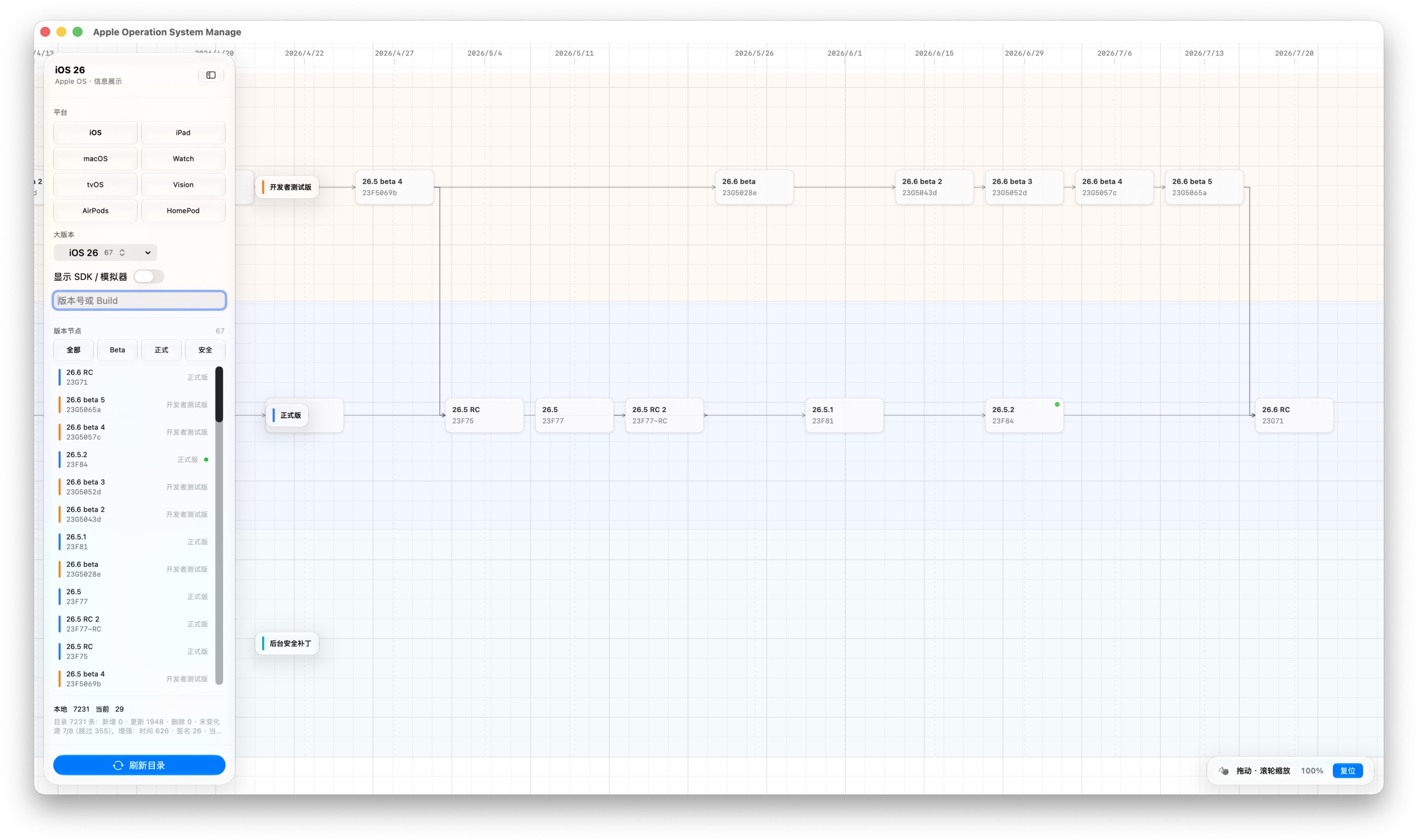
聚合版本发布日期、版本号、Build、IPSW 下载、包大小、Beta/RC/正式版通道与后台安全改进(BSI),并按大版本系列展示为可缩放、可跳转的横向时间轴。

iOS 26 系列路线图:开发者测试版 / 正式版 / 后台安全补丁

截图

节点详情(发布信息、签名状态、OTA / IPSW 入口)

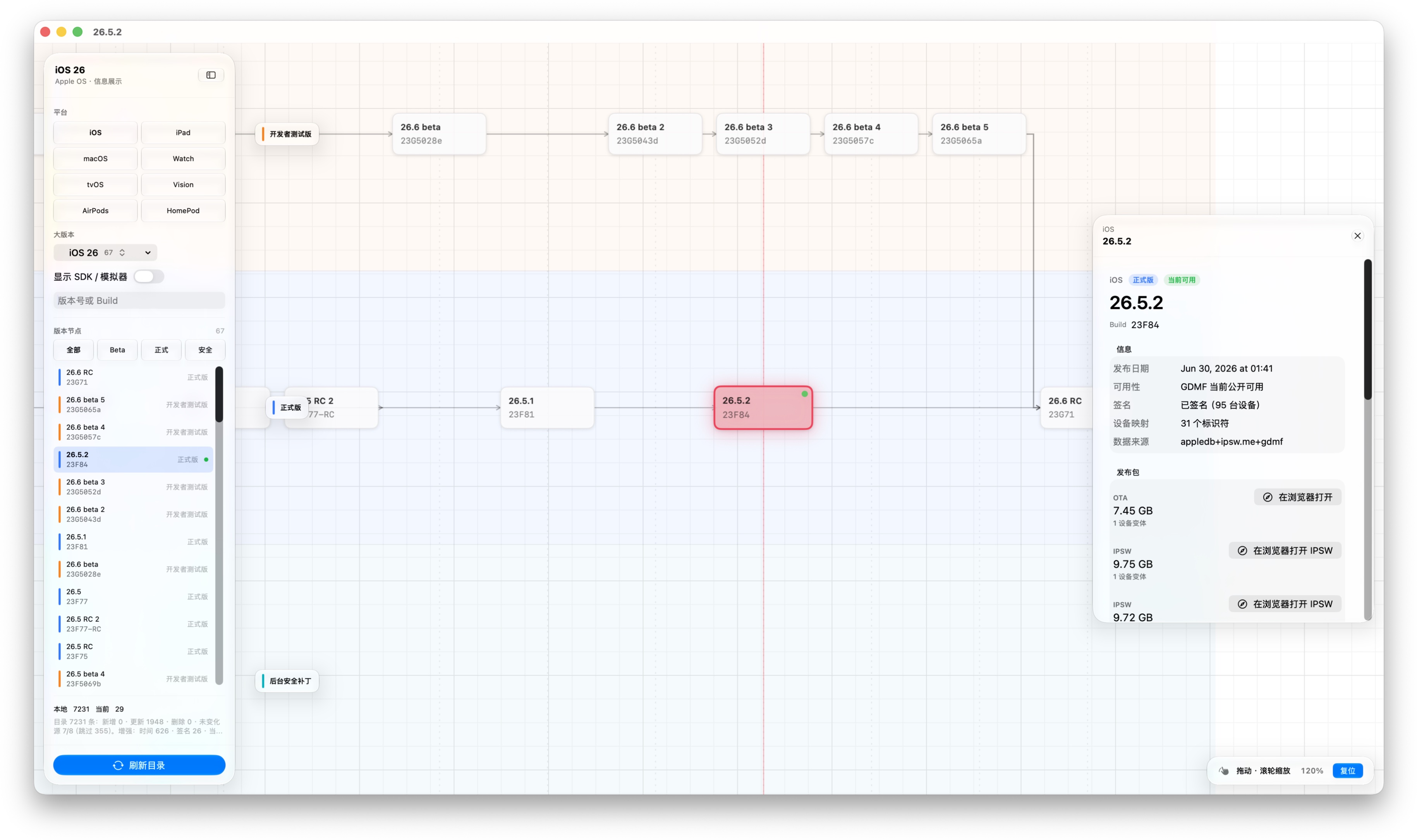
选中 26.5.2 节点详情面板

功能

  • 覆盖 iOS、iPadOS、macOS、watchOS、tvOS、visionOS、AirPods 与 audioOS
  • 开发者测试版、正式版及后台安全补丁分泳道展示
  • 左侧版本目录搜索与节点定位,画布支持拖动、滚轮缩放和连续节点切换
  • 节点详情展示发布日期、签名状态、设备兼容性与 IPSW/OTA 下载入口
  • 启动时自动增量同步,并利用 ETag 与 Last-Modified 减少重复下载
  • 原生 SwiftUI Liquid Glass 界面,支持浅色与深色外观
文档 内容
docs/PLAN.md 产品计划与分期(v0.5)
docs/ROADMAP-TIMELINE.md 系列泳道路线图定义
docs/P3-REPORT.md P3 报告
docs/api-contract.md 字段映射
docs/P0-REPORT.md · P1 · P2 前序报告

数据源(摘要)

角色 源 作用 状态
主库 AppleDB API 全历史、Beta/RC/BSI、IPSW URL ✅
辅源 ipsw.me v4 正式版秒级时间、签名抽样 ✅
官方校验 GDMF gdmf.apple.com/v2/pmv 当前可用 + BSI ✅

侧重:信息展示(时间轴 / 元数据)。不做:镜像/托管 IPSW;仅深链 Apple CDN。

系统要求

  • macOS 27 或更高版本
  • Apple Silicon Mac
  • 从源码构建需要 Xcode 27 或更高版本

构建与运行

  1. 用 Xcode 打开 Apple Operation System Manage/Apple Operation System Manage.xcodeproj
  2. 选择 Apple Operation System Manage scheme
  3. 在 macOS 目标上运行

也可以使用项目脚本:

./scripts/build_and_run.sh --verify   # 构建并启动验证
./scripts/build_and_run.sh build      # 仅构建

测试与探活

./scripts/run_tests.sh                # 编译生产源码并运行逻辑断言
python3 scripts/p0/probe_sources.py   # 数据源探活
展开 README ↓ 收起 README ↑

Apple OS Version Manager

面向 macOS 27 的苹果操作系统版本路线图工具。

聚合版本发布日期、版本号、Build、IPSW 下载、包大小、Beta/RC/正式版通道与后台安全改进(BSI),并按大版本系列展示为可缩放、可跳转的横向时间轴。

iOS 26 系列路线图:开发者测试版 / 正式版 / 后台安全补丁

截图

节点详情(发布信息、签名状态、OTA / IPSW 入口)

选中 26.5.2 节点详情面板

功能

  • 覆盖 iOS、iPadOS、macOS、watchOS、tvOS、visionOS、AirPods 与 audioOS
  • 开发者测试版、正式版及后台安全补丁分泳道展示
  • 左侧版本目录搜索与节点定位,画布支持拖动、滚轮缩放和连续节点切换
  • 节点详情展示发布日期、签名状态、设备兼容性与 IPSW/OTA 下载入口
  • 启动时自动增量同步,并利用 ETag 与 Last-Modified 减少重复下载
  • 原生 SwiftUI Liquid Glass 界面,支持浅色与深色外观
文档 内容
docs/PLAN.md 产品计划与分期(v0.5)
docs/ROADMAP-TIMELINE.md 系列泳道路线图定义
docs/P3-REPORT.md P3 报告
docs/api-contract.md 字段映射
docs/P0-REPORT.md · P1 · P2 前序报告

数据源(摘要)

角色 源 作用 状态
主库 AppleDB API 全历史、Beta/RC/BSI、IPSW URL ✅
辅源 ipsw.me v4 正式版秒级时间、签名抽样 ✅
官方校验 GDMF gdmf.apple.com/v2/pmv 当前可用 + BSI ✅

侧重:信息展示(时间轴 / 元数据)。不做:镜像/托管 IPSW;仅深链 Apple CDN。

系统要求

  • macOS 27 或更高版本
  • Apple Silicon Mac
  • 从源码构建需要 Xcode 27 或更高版本

构建与运行

  1. 用 Xcode 打开 Apple Operation System Manage/Apple Operation System Manage.xcodeproj
  2. 选择 Apple Operation System Manage scheme
  3. 在 macOS 目标上运行

也可以使用项目脚本:

./scripts/build_and_run.sh --verify   # 构建并启动验证
./scripts/build_and_run.sh build      # 仅构建

测试与探活

./scripts/run_tests.sh                # 编译生产源码并运行逻辑断言
python3 scripts/p0/probe_sources.py   # 数据源探活
06 PUBLIC / GITHUB ↗

Swift / 2026年7月

cloudward-ui-open-source

UI-only SwiftUI design snapshot for Cloudward

★ 1 ⑂ 0 MIT 2026年7月
LANGUAGE MIX 1 languages
  • Swift100.0%
FILE TREE / TOP LEVEL 4 entries
├── ▾ iCloudManageTool/
├── .gitignore
├── LICENSE
└── README.md
README README.md

归云 Cloudward UI

归云是一个面向 macOS 的 iCloud 云盘空间整理工具。本仓库只开源页面设计层,用于展示 SwiftUI 视图结构、视觉 token、页面布局与交互稿。

开源范围

本仓库包含:

  • iCloudManageTool/Views: 主要 SwiftUI 页面与组件
  • iCloudManageTool/DesignSystem: 颜色与动效 token
  • iCloudManageTool/Assets.xcassets: 应用图标与基础视觉资源

本仓库不包含:

  • iCloud 文件索引、扫描、统计、释放算法
  • 文件占用检测、进程检测、元数据监听
  • CloudwardCore
  • 生产 ViewModel、Services、测试夹具与私有工程配置

因此,这里的源码是 UI-only snapshot,不是完整可编译的产品源码。部分 View 中保留了对私有模型或核心模块的引用,仅用于说明页面接线位置。

视图结构

iCloudManageTool/Views/
  ContentView.swift           # 主窗口布局
  SidebarView.swift           # 侧边导航栏
  FileBrowserView.swift       # 文件浏览器
  FileTreeRow.swift           # 文件树行组件
  ExpandedDashboardCard.swift # 展开式仪表板
  InspectorView.swift         # 信息面板
  ReleaseFlowView.swift       # 释放流程
  HistoryView.swift           # 历史记录
  SyncStatusView.swift        # 同步状态
  MenuBarStatusView.swift     # 菜单栏状态
  OnboardingView.swift        # 新手引导
  SettingsView.swift          # 设置页
  ScanCenter/
    ScanCenterView.swift      # 扫描中心
  CloudRippleView.swift       # 涟漪反馈动画
  ByteValueText.swift         # 字节值显示
  PlaceholderPage.swift       # 占位页
  SelectionActionBar.swift    # 选择操作栏
  TopToolbarView.swift        # 顶部工具栏

Beta 构建

Release 中的 Cloudward-beta-3-macos.zip 是当前 macOS beta 3 构建包,可用于试用现阶段界面与流程。该构建仍处于 prerelease 阶段,请先在非关键文件上试用。

Beta 3 重点:

  • 全新设计系统: 语义化 accent token、统一卡片样式、经过色盲安全验证的图表分类色板(亮/暗双模式)。
  • 空间分析页由环形图改为带直接标注的横向量级条形图,文本全部回归文字色。
  • 释放流程动效重做: 滚动数字过渡、平滑环形进度与端点光点、SF Symbol 动效; 修复高频更新时文字糊化。
  • 同步状态页重建: 统计磁贴、实时时间戳、传输/冲突卡片、诊断日志导出入口。
  • 大量性能优化: 索引重建并行化与去 IPC、主线程派生统计改为后台刷新、释放过程增量索引补丁; 修复大批量释放时的崩溃。
  • 修复包目录(如 .fcpbundle)内容无法在文件树中展开显示的问题。

许可

UI 设计层源码以 MIT License 开源。归云名称、图标与完整产品逻辑仍保留所有权利。

展开 README ↓ 收起 README ↑

归云 Cloudward UI

归云是一个面向 macOS 的 iCloud 云盘空间整理工具。本仓库只开源页面设计层,用于展示 SwiftUI 视图结构、视觉 token、页面布局与交互稿。

开源范围

本仓库包含:

  • iCloudManageTool/Views: 主要 SwiftUI 页面与组件
  • iCloudManageTool/DesignSystem: 颜色与动效 token
  • iCloudManageTool/Assets.xcassets: 应用图标与基础视觉资源

本仓库不包含:

  • iCloud 文件索引、扫描、统计、释放算法
  • 文件占用检测、进程检测、元数据监听
  • CloudwardCore
  • 生产 ViewModel、Services、测试夹具与私有工程配置

因此,这里的源码是 UI-only snapshot,不是完整可编译的产品源码。部分 View 中保留了对私有模型或核心模块的引用,仅用于说明页面接线位置。

视图结构

iCloudManageTool/Views/
  ContentView.swift           # 主窗口布局
  SidebarView.swift           # 侧边导航栏
  FileBrowserView.swift       # 文件浏览器
  FileTreeRow.swift           # 文件树行组件
  ExpandedDashboardCard.swift # 展开式仪表板
  InspectorView.swift         # 信息面板
  ReleaseFlowView.swift       # 释放流程
  HistoryView.swift           # 历史记录
  SyncStatusView.swift        # 同步状态
  MenuBarStatusView.swift     # 菜单栏状态
  OnboardingView.swift        # 新手引导
  SettingsView.swift          # 设置页
  ScanCenter/
    ScanCenterView.swift      # 扫描中心
  CloudRippleView.swift       # 涟漪反馈动画
  ByteValueText.swift         # 字节值显示
  PlaceholderPage.swift       # 占位页
  SelectionActionBar.swift    # 选择操作栏
  TopToolbarView.swift        # 顶部工具栏

Beta 构建

Release 中的 Cloudward-beta-3-macos.zip 是当前 macOS beta 3 构建包,可用于试用现阶段界面与流程。该构建仍处于 prerelease 阶段,请先在非关键文件上试用。

Beta 3 重点:

  • 全新设计系统: 语义化 accent token、统一卡片样式、经过色盲安全验证的图表分类色板(亮/暗双模式)。
  • 空间分析页由环形图改为带直接标注的横向量级条形图,文本全部回归文字色。
  • 释放流程动效重做: 滚动数字过渡、平滑环形进度与端点光点、SF Symbol 动效; 修复高频更新时文字糊化。
  • 同步状态页重建: 统计磁贴、实时时间戳、传输/冲突卡片、诊断日志导出入口。
  • 大量性能优化: 索引重建并行化与去 IPC、主线程派生统计改为后台刷新、释放过程增量索引补丁; 修复大批量释放时的崩溃。
  • 修复包目录(如 .fcpbundle)内容无法在文件树中展开显示的问题。

许可

UI 设计层源码以 MIT License 开源。归云名称、图标与完整产品逻辑仍保留所有权利。

07 PUBLIC / GITHUB ↗

Objective-C++ / 2026年7月

ShaderMetal

Experimental native Apple Metal renderer and hardware ray tracing backend for Minecraft Fabric, adapted from Radiance architecture.

★ 4 ⑂ 1 GPL-3.0 2026年7月
  • #apple-silicon
  • #fabric
  • #macos
  • #metal
  • #minecraft
  • #ray-tracing
LANGUAGE MIX 7 languages
  • Objective-C++54.9%
  • Java21.5%
  • C++10.4%
  • Metal10.3%
  • Shell1.8%
  • CMake0.5%
  • C0.5%
FILE TREE / TOP LEVEL 9 entries
├── ▾ .github/
├── ▾ shader-metal-template-1.21.4/
├── ▾ 文档/
├── .gitignore
├── .gitmodules
├── LICENSE
├── PROVENANCE.md
├── README.md
└── THIRD_PARTY_NOTICES.md
README README.md

ShaderMetal

ShaderMetal is an experimental client-side Fabric mod that replaces Minecraft's OpenGL presentation path with a native Apple Metal renderer on Apple Silicon.

The implementation is under active development. It is currently a research preview, not a drop-in production renderer, and worlds should be backed up before testing.

Status

  • Stage A: native Metal frame foundation complete.
  • Stage B: Metal rasterization path complete.
  • Stage C: Apple Metal ray tracing integration in progress. The current path builds native acceleration structures, performs ray intersections through Metal, and uses MetalFX temporal denoising/upscaling where supported. Visual stability and performance tuning are ongoing.

The source project is in shader-metal-template-1.21.4.

Requirements

  • Minecraft Java Edition 1.21.4
  • Fabric Loader 0.19.2 or newer and Fabric API
  • Apple Silicon Mac with a Metal device that reports ray-tracing support
  • Current development target: macOS 26 or newer
  • JDK 21, CMake 3.20 or newer, xxd, and Xcode Command Line Tools

Current testing is limited to an M5 Mac on macOS 27 beta. Other Macs and mod combinations are unverified.

Build

git clone --recurse-submodules https://github.com/LingXiFox/ShaderMetal.git
cd ShaderMetal/shader-metal-template-1.21.4
./script/gradle_task.sh build

The mod JAR is written to build/libs/. All local Gradle invocations should go through script/gradle_task.sh; it disables persistent daemons and cleans project Java/game processes when the task exits.

To start the development client:

./script/gradle_task.sh runClient

Known Limitations

  • Stage C still has visible ray-tracing noise, shadow/material artifacts, and frame-time spikes.
  • Geometry updates, water/transparency history, dynamic entities, and some UI/input paths remain under active repair.
  • MetalFX frame interpolation is not implemented.
  • The current renderer is hybrid: Metal rasterization supplies primary visibility and fallback data while Metal hardware ray tracing computes experimental lighting and shadows.
  • There are no stable release binaries, compatibility guarantees, or production-world safety guarantees yet.

Radiance Attribution

ShaderMetal borrows the renderer-replacement approach and the Java/Mixin/JNI proxy-contract design from Minecraft-Radiance/Radiance. Radiance and its native MCVR backend are the architectural references; ShaderMetal reimplements the native renderer for Apple Metal, Objective-C++, Apple ray-tracing acceleration structures, and MetalFX.

ShaderMetal is not affiliated with or endorsed by the Radiance project, Mojang Studios, Microsoft, or Apple. Detailed provenance and modification notes are recorded in PROVENANCE.md and THIRD_PARTY_NOTICES.md.

License

Copyright (C) 2026 LingXiFox for ShaderMetal modifications and the original Metal implementation.

ShaderMetal's project-owned source code is distributed under the GNU General Public License version 3 only (GPL-3.0-only). Third-party submodules and dependencies retain their respective licenses. See LICENSE and THIRD_PARTY_NOTICES.md.

展开 README ↓ 收起 README ↑

ShaderMetal

ShaderMetal is an experimental client-side Fabric mod that replaces Minecraft's OpenGL presentation path with a native Apple Metal renderer on Apple Silicon.

The implementation is under active development. It is currently a research preview, not a drop-in production renderer, and worlds should be backed up before testing.

Status

  • Stage A: native Metal frame foundation complete.
  • Stage B: Metal rasterization path complete.
  • Stage C: Apple Metal ray tracing integration in progress. The current path builds native acceleration structures, performs ray intersections through Metal, and uses MetalFX temporal denoising/upscaling where supported. Visual stability and performance tuning are ongoing.

The source project is in shader-metal-template-1.21.4.

Requirements

  • Minecraft Java Edition 1.21.4
  • Fabric Loader 0.19.2 or newer and Fabric API
  • Apple Silicon Mac with a Metal device that reports ray-tracing support
  • Current development target: macOS 26 or newer
  • JDK 21, CMake 3.20 or newer, xxd, and Xcode Command Line Tools

Current testing is limited to an M5 Mac on macOS 27 beta. Other Macs and mod combinations are unverified.

Build

git clone --recurse-submodules https://github.com/LingXiFox/ShaderMetal.git
cd ShaderMetal/shader-metal-template-1.21.4
./script/gradle_task.sh build

The mod JAR is written to build/libs/. All local Gradle invocations should go through script/gradle_task.sh; it disables persistent daemons and cleans project Java/game processes when the task exits.

To start the development client:

./script/gradle_task.sh runClient

Known Limitations

  • Stage C still has visible ray-tracing noise, shadow/material artifacts, and frame-time spikes.
  • Geometry updates, water/transparency history, dynamic entities, and some UI/input paths remain under active repair.
  • MetalFX frame interpolation is not implemented.
  • The current renderer is hybrid: Metal rasterization supplies primary visibility and fallback data while Metal hardware ray tracing computes experimental lighting and shadows.
  • There are no stable release binaries, compatibility guarantees, or production-world safety guarantees yet.

Radiance Attribution

ShaderMetal borrows the renderer-replacement approach and the Java/Mixin/JNI proxy-contract design from Minecraft-Radiance/Radiance. Radiance and its native MCVR backend are the architectural references; ShaderMetal reimplements the native renderer for Apple Metal, Objective-C++, Apple ray-tracing acceleration structures, and MetalFX.

ShaderMetal is not affiliated with or endorsed by the Radiance project, Mojang Studios, Microsoft, or Apple. Detailed provenance and modification notes are recorded in PROVENANCE.md and THIRD_PARTY_NOTICES.md.

License

Copyright (C) 2026 LingXiFox for ShaderMetal modifications and the original Metal implementation.

ShaderMetal's project-owned source code is distributed under the GNU General Public License version 3 only (GPL-3.0-only). Third-party submodules and dependencies retain their respective licenses. See LICENSE and THIRD_PARTY_NOTICES.md.

09 PUBLIC / GITHUB ↗

Where Winds Meet Linux DLSS and Frame Generation troubleshooting guide

★ 0 ⑂ 0 2026年6月
LANGUAGE MIX

DOCS ONLY / NO CODE DETECTED

FILE TREE / TOP LEVEL 1 entries
└── README.md
README README.md

燕云十六声 / Where Winds Meet 在 Linux 下启用 DLSS、帧生成和 Reflex 的排障记录

本文记录一次在 Arch Linux + Niri Wayland + NVIDIA Laptop GPU 环境中,让《燕云十六声 / Where Winds Meet》在 Proton/Wine 下显示并启用 DLSS、DLSS Frame Generation 和 Reflex Low Latency 的完整排障过程。

这不是通用补丁包,而是一条可复查的排障路径。不同发行版、Proton 版本、显卡驱动和游戏版本可能需要调整。

最终结果

已确认可用:

  • DLSS Super Resolution 选项出现并可使用。
  • DLSS Frame Generation 可开启。
  • Reflex 降低延迟可开启。
  • 调试日志参数已移除,可以正常游玩。

最终稳定配置备份在本机:

/data/Games/yysls-dlss-fg-final-backup-20260626-100824

测试环境

发行版:Arch Linux
桌面环境:Niri 26.04 Wayland
GPU:NVIDIA GeForce RTX 4090 Laptop GPU
驱动:nvidia-open 610.43.02
Wine/Proton runner:proton-cachyos-11.0 via Lutris/umu
游戏 AppID:3564740
Wine prefix:/data/Games/yysls
实际游戏目录:C:\Program Files\yysls\yysls_medium\Engine\Binaries\Win64rh
Streamline 版本:2.11.1

本环境是单 NVIDIA GPU 使用场景,Intel/AMD GPU 被隐藏或禁用。多 GPU 笔记本可能需要额外处理适配器选择。

起始症状

游戏可运行,DX12 也已开启,但图形设置里没有 DLSS 选项。

初期 Streamline 日志显示所有插件都加载失败:

Failed to load plugin '.../Streamline/sl.common.dll' - last error unknown error
Failed to load plugin '.../Streamline/sl.dlss.dll' - last error unknown error
Failed to load plugin '.../Streamline/sl.dlss_g.dll' - last error unknown error
Failed to load plugin '.../Streamline/sl.reflex.dll' - last error unknown error

同时 DXVK-NVAPI 日志能识别显卡:

NvAPI Device: NVIDIA GeForce RTX 4090 Laptop GPU (610.43.2)
<-NvAPI_Initialize: OK

这说明问题不在“完全没有 NVAPI”或“识别不到 NVIDIA GPU”,而在 NVIDIA Streamline 插件加载链路。

最终 Lutris 环境变量

最终保留的 Lutris 配置如下,诊断日志参数已移除:

system:
  env:
    SteamGameId: "3564740"
    SteamAppId: "3564740"
    DXVK_ENABLE_NVAPI: "1"
    PROTON_ENABLE_NVAPI: "1"
    PROTON_HIDE_NVIDIA_GPU: "0"
    DXVK_NVAPI_DISABLE_ENTRYPOINTS: "NvAPI_D3D12_SetFlipConfig"
    VKD3D_CONFIG: "dxr,dxr11"
    DXVK_NVAPI_DRS_NGX_DLSS_SR_OVERRIDE: "on"
    DXVK_NVAPI_DRS_NGX_DLSS_RR_OVERRIDE: "on"
    DXVK_NVAPI_DRS_NGX_DLSSG_MODE: "auto"
    DXVK_NVAPI_DRS_NGX_DLSS_SR_OVERRIDE_RENDER_PRESET_SELECTION: "render_preset_latest"
    WINE_HIDE_INTEL_GPU: "1"
    WINE_HIDE_AMD_GPU: "1"
    VKD3D_VULKAN_DEVICE: "0"
    WINEDLLOVERRIDES: "wintrust,crypt32=b;msasn1=n,b;nvapi,nvapi64,nvngx=n"

游戏启动器配置里还需要:

DX12=true

本机路径:

/data/Games/yysls/drive_c/Program Files/yysls/Win32/deploy/setting.ini

Wine DLL override 关键点

最终有效组合是:

wintrust,crypt32=b;msasn1=n,b;nvapi,nvapi64,nvngx=n

含义:

  • wintrust=b:使用 Wine builtin wintrust。
  • crypt32=b:使用 Wine builtin crypt32。
  • msasn1=n,b:优先使用 Windows native msasn1.dll,回退 builtin。
  • nvapi,nvapi64,nvngx=n:确保使用 native/proxy NVAPI/NGX 路径。

对应注册表中保留了这些全局 override:

[Software\\Wine\\DllOverrides]
"*crypt32"="builtin"
"*msasn1"="native,builtin"
"*wintrust"="builtin"
"crypt32"="builtin"
"msasn1"="native,builtin"
"wintrust"="builtin"
"nvapi"="native"
"nvapi64"="native"

注意:msasn1.dll 来自 Windows 组件。不要把 Windows DLL 放进公开仓库。可以用本机已有的 winetricks 缓存或合法来源提取,并只记录步骤,不分发文件。

排障过程

1. 确认 DX12 与游戏实际运行目录

游戏真正使用的是:

C:\Program Files\yysls\yysls_medium\Engine\Binaries\Win64rh

Streamline 插件目录在:

Win64rh\Streamline

其中存在:

sl.common.dll
sl.dlss.dll
sl.dlss_g.dll
sl.reflex.dll
nvngx_dlss.dll
nvngx_dlssg.dll

setting.ini 中 DX12=true 已确认。

2. 排除 NVAPI 完全不可用

nvapi64.log 显示 DXVK-NVAPI 能正常识别 RTX 4090 Laptop:

DXVK-NVAPI cachyos-11.0-20260429-slr+ NVAPI gcc 14.0.0 x86_64 plain (yysls.exe)
NvAPI Device: NVIDIA GeForce RTX 4090 Laptop GPU (610.43.2)
<-NvAPI_Initialize: OK

所以 DLSS 不出现的第一根因不是 GPU 识别失败。

3. 发现 Streamline 插件安全加载失败

Streamline v2.11.1 会在生产版中通过 security::loadLibrary() 加载插件。

流程简化后是:

if (verifyEmbeddedSignature(path))
{
    mod = LoadLibraryW(path);
}

也就是说,插件本身能不能 LoadLibraryW 成功还不够,必须先通过签名验证。

短探针确认:

  • sl.common.dll、sl.dlss.dll、sl.dlss_g.dll、sl.reflex.dll 可被 LoadLibraryW 加载。
  • 导出 slGetPluginFunction 存在。

因此问题集中到签名校验。

4. Wine builtin msasn1 导致 WinVerifyTrust 失败

初始 WinVerifyTrust 探针结果:

WinVerifyTrust(.../sl.*.dll) => 0x80093108

配合 WINEDEBUG=+wintrust,+crypt 可见失败来自 Wine builtin msasn1 的 ASN.1 解析路径。

替换/启用 Windows native msasn1.dll 后,普通签名校验从 0x80093108 前进到其它错误,说明方向正确。

5. 不要用 native wintrust + native crypt32 作为最终方案

曾测试 native wintrust.dll 和 native crypt32.dll,普通签名路径一度可以通过,但 secondary signature 路径不稳定,甚至出现崩溃或 0x80090008。

最终可用组合是:

builtin wintrust + builtin crypt32 + native msasn1

这个组合能让 Streamline 需要的 secondary signature 路径通过。

探针结果:

WinVerifyTrustSecondary(.../sl.common.dll) => 0x00000000 secondary=1 verified=0

完整复刻 Streamline 的 NVIDIA nested signature 校验后也通过:

decode public key => 1 err=0 len=411 expected=411
public key memcmp => match

6. 删除 PROTON_FORCE_NVAPI

曾发现 PROTON_FORCE_NVAPI=1 会触发 runner 的 forcenvapi,导致:

DXVK_NVAPI_ALLOW_OTHER_DRIVERS=1
DXVK_NVAPI_DRIVER_VERSION=99999

日志表现:

DXVK_NVAPI_DRIVER_VERSION is set to '99999', reporting driver version 999.99

这对本机 NVIDIA 单 GPU 环境没有必要,还会污染后续判断。最终删除 PROTON_FORCE_NVAPI,只保留:

DXVK_ENABLE_NVAPI=1
PROTON_ENABLE_NVAPI=1
PROTON_HIDE_NVIDIA_GPU=0

7. 修复后 DLSS 插件加载成功

修复签名链后,Streamline 日志进入正常插件加载阶段:

Loaded plugin 'sl.common'
Loaded plugin 'sl.dlss'
Loaded plugin 'sl.dlss_g'
Loaded plugin 'sl.reflex'
Plugin execution order based on priority:
P0 - sl.common
P100 - sl.dlss
P100 - sl.reflex
P1000 - sl.dlss_g

NGX 也能加载游戏自带 DLL:

Loaded NGXCore from path (.../Streamline/nvngx_dlss.dll)
Loaded NGXCore from path (.../Streamline/nvngx_dlssg.dll)

此时 DLSS 选项开始出现。

帧生成卡死与最终解法

修复 Streamline 后,sl.dlss_g 也能加载,但初次开启帧生成时游戏在加载阶段卡住。

关键 NVAPI 日志:

nvapi_QueryInterface (NvAPI_D3D12_SetFlipConfig): Not implemented method

这说明当前 DXVK-NVAPI 暴露或处理 NvAPI_D3D12_SetFlipConfig 的方式会让 DLSS-G 路径走到不稳定分支。

临时禁用 sl.dlss_g.dll 后,DLSS-SR 可稳定出现并可玩,说明问题只集中在 Frame Generation 插件。

最终可用方案不是禁用 sl.dlss_g,而是:

DXVK_NVAPI_DISABLE_ENTRYPOINTS: "NvAPI_D3D12_SetFlipConfig"
DXVK_NVAPI_DRS_NGX_DLSSG_MODE: "auto"

并且不要恢复强制 FG override:

# 不要设置这个
DXVK_NVAPI_DRS_NGX_DLSS_FG_OVERRIDE: "on"

这样 sl.dlss_g 能加载,Frame Generation 能开启,同时绕开卡住的 SetFlipConfig 入口。

最终确认:

  • DLSS 超分出现。
  • Frame Generation 可开启。
  • Reflex Low Latency 可开启。

为什么不建议走 Wine win32u 补丁路线

中途曾尝试追 Wine/Proton 的 win32u.so D3DKMT 补丁方向,结果:

  • 11.11 ABI 不兼容,容易崩溃。
  • 11.0 二进制替换有 OOM 和整机卡死风险。
  • ProtonDB/GamingOnLinux 公开信息没有显示该游戏必须靠 D3DKMT type 15 补丁才能 DLSS。

最终证明问题主线在 Streamline 签名校验和 DLSS-G 的 NVAPI entrypoint,而不是 win32u.so。

最小复现/验证思路

如果要在其他机器上验证,建议按这个顺序:

  1. 确认 DX12 开启。
  2. 确认 DXVK-NVAPI 能识别 NVIDIA GPU。
  3. 开启临时 Streamline 日志:
SL_LOG_LEVEL: "2"
SL_LOG_PATH: "C:\\users\\<user>\\AppData\\Local\\Temp"
SL_LOG_NAME: "yysls-streamline.log"
  1. 如果看到所有 sl.*.dll 都 Failed to load plugin,优先查签名校验。
  2. 如果 sl.dlss 成功但 sl.dlss_g 卡住,查 NvAPI_D3D12_SetFlipConfig。
  3. 验证完后删除日志参数,避免日志长期增长。

临时 NVAPI 日志参数:

DXVK_NVAPI_LOG_LEVEL: "info"
DXVK_NVAPI_LOG_PATH: "C:\\users\\<user>\\AppData\\Local\\Temp"

验证完也应删除。

最终清理后的运行配置

最终运行时不保留诊断日志参数。完整配置如下:

game:
  exe: /home/lingxi/Games/yysls/drive_c/Program Files/yysls/Win32/deploy/launcher.exe
  prefix: /home/lingxi/Games/yysls
  working_dir: /home/lingxi/Games/yysls/drive_c/Program Files/yysls/Win32/deploy
wine:
  version: proton-cachyos-11.0
  show_debug: "-all"
system:
  env:
    SteamGameId: "3564740"
    SteamAppId: "3564740"
    DXVK_ENABLE_NVAPI: "1"
    PROTON_ENABLE_NVAPI: "1"
    PROTON_HIDE_NVIDIA_GPU: "0"
    DXVK_NVAPI_DISABLE_ENTRYPOINTS: "NvAPI_D3D12_SetFlipConfig"
    VKD3D_CONFIG: "dxr,dxr11"
    DXVK_NVAPI_DRS_NGX_DLSS_SR_OVERRIDE: "on"
    DXVK_NVAPI_DRS_NGX_DLSS_RR_OVERRIDE: "on"
    DXVK_NVAPI_DRS_NGX_DLSSG_MODE: "auto"
    DXVK_NVAPI_DRS_NGX_DLSS_SR_OVERRIDE_RENDER_PRESET_SELECTION: "render_preset_latest"
    WINE_HIDE_INTEL_GPU: "1"
    WINE_HIDE_AMD_GPU: "1"
    VKD3D_VULKAN_DEVICE: "0"
    WINEDLLOVERRIDES: "wintrust,crypt32=b;msasn1=n,b;nvapi,nvapi64,nvngx=n"

回退方案

如果 Frame Generation 又导致卡死,但 DLSS-SR 要保留,可以临时禁用 DLSS-G 插件:

WINEDLLOVERRIDES: "sl.dlss_g=d;wintrust,crypt32=b;msasn1=n,b;nvapi,nvapi64,nvngx=n"

这会保留 DLSS 超分,关闭 Frame Generation。

本机有一个 DLSS-SR 稳定态备份:

/data/Games/yysls-dlss-fg-final-backup-20260626-100824/opencode-artifacts/yysls-dlss-working-20260626-095828

不建议做的事

  • 不要长期保留 SL_LOG_*、DXVK_NVAPI_LOG_*、WINEDEBUG=+... 这类日志参数。
  • 不要启用 PROTON_FORCE_NVAPI=1,它会触发 driver spoof 到 999.99。
  • 不要直接替换 runner 的 win32u.so,除非明确知道 ABI 与 runner 完全匹配。
  • 不要把 native wintrust.dll + native crypt32.dll 当作最终方案,本次测试 secondary signature 路径不稳定。
  • 不要把 Windows DLL 上传到 GitHub 仓库。

一句话总结

这次 DLSS 不出现的核心原因是 Streamline 插件安全加载被 Wine 的签名校验链卡住。用 builtin wintrust/crypt32 加 native msasn1 后,sl.dlss、sl.dlss_g、sl.reflex 能正常加载。Frame Generation 的加载卡死来自 NvAPI_D3D12_SetFlipConfig 路径,隐藏该 entrypoint 并让 DLSSG 走 auto 后,DLSS、帧生成和 Reflex 都可用。

展开 README ↓ 收起 README ↑

燕云十六声 / Where Winds Meet 在 Linux 下启用 DLSS、帧生成和 Reflex 的排障记录

本文记录一次在 Arch Linux + Niri Wayland + NVIDIA Laptop GPU 环境中,让《燕云十六声 / Where Winds Meet》在 Proton/Wine 下显示并启用 DLSS、DLSS Frame Generation 和 Reflex Low Latency 的完整排障过程。

这不是通用补丁包,而是一条可复查的排障路径。不同发行版、Proton 版本、显卡驱动和游戏版本可能需要调整。

最终结果

已确认可用:

  • DLSS Super Resolution 选项出现并可使用。
  • DLSS Frame Generation 可开启。
  • Reflex 降低延迟可开启。
  • 调试日志参数已移除,可以正常游玩。

最终稳定配置备份在本机:

/data/Games/yysls-dlss-fg-final-backup-20260626-100824

测试环境

发行版:Arch Linux
桌面环境:Niri 26.04 Wayland
GPU:NVIDIA GeForce RTX 4090 Laptop GPU
驱动:nvidia-open 610.43.02
Wine/Proton runner:proton-cachyos-11.0 via Lutris/umu
游戏 AppID:3564740
Wine prefix:/data/Games/yysls
实际游戏目录:C:\Program Files\yysls\yysls_medium\Engine\Binaries\Win64rh
Streamline 版本:2.11.1

本环境是单 NVIDIA GPU 使用场景,Intel/AMD GPU 被隐藏或禁用。多 GPU 笔记本可能需要额外处理适配器选择。

起始症状

游戏可运行,DX12 也已开启,但图形设置里没有 DLSS 选项。

初期 Streamline 日志显示所有插件都加载失败:

Failed to load plugin '.../Streamline/sl.common.dll' - last error unknown error
Failed to load plugin '.../Streamline/sl.dlss.dll' - last error unknown error
Failed to load plugin '.../Streamline/sl.dlss_g.dll' - last error unknown error
Failed to load plugin '.../Streamline/sl.reflex.dll' - last error unknown error

同时 DXVK-NVAPI 日志能识别显卡:

NvAPI Device: NVIDIA GeForce RTX 4090 Laptop GPU (610.43.2)
<-NvAPI_Initialize: OK

这说明问题不在“完全没有 NVAPI”或“识别不到 NVIDIA GPU”,而在 NVIDIA Streamline 插件加载链路。

最终 Lutris 环境变量

最终保留的 Lutris 配置如下,诊断日志参数已移除:

system:
  env:
    SteamGameId: "3564740"
    SteamAppId: "3564740"
    DXVK_ENABLE_NVAPI: "1"
    PROTON_ENABLE_NVAPI: "1"
    PROTON_HIDE_NVIDIA_GPU: "0"
    DXVK_NVAPI_DISABLE_ENTRYPOINTS: "NvAPI_D3D12_SetFlipConfig"
    VKD3D_CONFIG: "dxr,dxr11"
    DXVK_NVAPI_DRS_NGX_DLSS_SR_OVERRIDE: "on"
    DXVK_NVAPI_DRS_NGX_DLSS_RR_OVERRIDE: "on"
    DXVK_NVAPI_DRS_NGX_DLSSG_MODE: "auto"
    DXVK_NVAPI_DRS_NGX_DLSS_SR_OVERRIDE_RENDER_PRESET_SELECTION: "render_preset_latest"
    WINE_HIDE_INTEL_GPU: "1"
    WINE_HIDE_AMD_GPU: "1"
    VKD3D_VULKAN_DEVICE: "0"
    WINEDLLOVERRIDES: "wintrust,crypt32=b;msasn1=n,b;nvapi,nvapi64,nvngx=n"

游戏启动器配置里还需要:

DX12=true

本机路径:

/data/Games/yysls/drive_c/Program Files/yysls/Win32/deploy/setting.ini

Wine DLL override 关键点

最终有效组合是:

wintrust,crypt32=b;msasn1=n,b;nvapi,nvapi64,nvngx=n

含义:

  • wintrust=b:使用 Wine builtin wintrust。
  • crypt32=b:使用 Wine builtin crypt32。
  • msasn1=n,b:优先使用 Windows native msasn1.dll,回退 builtin。
  • nvapi,nvapi64,nvngx=n:确保使用 native/proxy NVAPI/NGX 路径。

对应注册表中保留了这些全局 override:

[Software\\Wine\\DllOverrides]
"*crypt32"="builtin"
"*msasn1"="native,builtin"
"*wintrust"="builtin"
"crypt32"="builtin"
"msasn1"="native,builtin"
"wintrust"="builtin"
"nvapi"="native"
"nvapi64"="native"

注意:msasn1.dll 来自 Windows 组件。不要把 Windows DLL 放进公开仓库。可以用本机已有的 winetricks 缓存或合法来源提取,并只记录步骤,不分发文件。

排障过程

1. 确认 DX12 与游戏实际运行目录

游戏真正使用的是:

C:\Program Files\yysls\yysls_medium\Engine\Binaries\Win64rh

Streamline 插件目录在:

Win64rh\Streamline

其中存在:

sl.common.dll
sl.dlss.dll
sl.dlss_g.dll
sl.reflex.dll
nvngx_dlss.dll
nvngx_dlssg.dll

setting.ini 中 DX12=true 已确认。

2. 排除 NVAPI 完全不可用

nvapi64.log 显示 DXVK-NVAPI 能正常识别 RTX 4090 Laptop:

DXVK-NVAPI cachyos-11.0-20260429-slr+ NVAPI gcc 14.0.0 x86_64 plain (yysls.exe)
NvAPI Device: NVIDIA GeForce RTX 4090 Laptop GPU (610.43.2)
<-NvAPI_Initialize: OK

所以 DLSS 不出现的第一根因不是 GPU 识别失败。

3. 发现 Streamline 插件安全加载失败

Streamline v2.11.1 会在生产版中通过 security::loadLibrary() 加载插件。

流程简化后是:

if (verifyEmbeddedSignature(path))
{
    mod = LoadLibraryW(path);
}

也就是说,插件本身能不能 LoadLibraryW 成功还不够,必须先通过签名验证。

短探针确认:

  • sl.common.dll、sl.dlss.dll、sl.dlss_g.dll、sl.reflex.dll 可被 LoadLibraryW 加载。
  • 导出 slGetPluginFunction 存在。

因此问题集中到签名校验。

4. Wine builtin msasn1 导致 WinVerifyTrust 失败

初始 WinVerifyTrust 探针结果:

WinVerifyTrust(.../sl.*.dll) => 0x80093108

配合 WINEDEBUG=+wintrust,+crypt 可见失败来自 Wine builtin msasn1 的 ASN.1 解析路径。

替换/启用 Windows native msasn1.dll 后,普通签名校验从 0x80093108 前进到其它错误,说明方向正确。

5. 不要用 native wintrust + native crypt32 作为最终方案

曾测试 native wintrust.dll 和 native crypt32.dll,普通签名路径一度可以通过,但 secondary signature 路径不稳定,甚至出现崩溃或 0x80090008。

最终可用组合是:

builtin wintrust + builtin crypt32 + native msasn1

这个组合能让 Streamline 需要的 secondary signature 路径通过。

探针结果:

WinVerifyTrustSecondary(.../sl.common.dll) => 0x00000000 secondary=1 verified=0

完整复刻 Streamline 的 NVIDIA nested signature 校验后也通过:

decode public key => 1 err=0 len=411 expected=411
public key memcmp => match

6. 删除 PROTON_FORCE_NVAPI

曾发现 PROTON_FORCE_NVAPI=1 会触发 runner 的 forcenvapi,导致:

DXVK_NVAPI_ALLOW_OTHER_DRIVERS=1
DXVK_NVAPI_DRIVER_VERSION=99999

日志表现:

DXVK_NVAPI_DRIVER_VERSION is set to '99999', reporting driver version 999.99

这对本机 NVIDIA 单 GPU 环境没有必要,还会污染后续判断。最终删除 PROTON_FORCE_NVAPI,只保留:

DXVK_ENABLE_NVAPI=1
PROTON_ENABLE_NVAPI=1
PROTON_HIDE_NVIDIA_GPU=0

7. 修复后 DLSS 插件加载成功

修复签名链后,Streamline 日志进入正常插件加载阶段:

Loaded plugin 'sl.common'
Loaded plugin 'sl.dlss'
Loaded plugin 'sl.dlss_g'
Loaded plugin 'sl.reflex'
Plugin execution order based on priority:
P0 - sl.common
P100 - sl.dlss
P100 - sl.reflex
P1000 - sl.dlss_g

NGX 也能加载游戏自带 DLL:

Loaded NGXCore from path (.../Streamline/nvngx_dlss.dll)
Loaded NGXCore from path (.../Streamline/nvngx_dlssg.dll)

此时 DLSS 选项开始出现。

帧生成卡死与最终解法

修复 Streamline 后,sl.dlss_g 也能加载,但初次开启帧生成时游戏在加载阶段卡住。

关键 NVAPI 日志:

nvapi_QueryInterface (NvAPI_D3D12_SetFlipConfig): Not implemented method

这说明当前 DXVK-NVAPI 暴露或处理 NvAPI_D3D12_SetFlipConfig 的方式会让 DLSS-G 路径走到不稳定分支。

临时禁用 sl.dlss_g.dll 后,DLSS-SR 可稳定出现并可玩,说明问题只集中在 Frame Generation 插件。

最终可用方案不是禁用 sl.dlss_g,而是:

DXVK_NVAPI_DISABLE_ENTRYPOINTS: "NvAPI_D3D12_SetFlipConfig"
DXVK_NVAPI_DRS_NGX_DLSSG_MODE: "auto"

并且不要恢复强制 FG override:

# 不要设置这个
DXVK_NVAPI_DRS_NGX_DLSS_FG_OVERRIDE: "on"

这样 sl.dlss_g 能加载,Frame Generation 能开启,同时绕开卡住的 SetFlipConfig 入口。

最终确认:

  • DLSS 超分出现。
  • Frame Generation 可开启。
  • Reflex Low Latency 可开启。

为什么不建议走 Wine win32u 补丁路线

中途曾尝试追 Wine/Proton 的 win32u.so D3DKMT 补丁方向,结果:

  • 11.11 ABI 不兼容,容易崩溃。
  • 11.0 二进制替换有 OOM 和整机卡死风险。
  • ProtonDB/GamingOnLinux 公开信息没有显示该游戏必须靠 D3DKMT type 15 补丁才能 DLSS。

最终证明问题主线在 Streamline 签名校验和 DLSS-G 的 NVAPI entrypoint,而不是 win32u.so。

最小复现/验证思路

如果要在其他机器上验证,建议按这个顺序:

  1. 确认 DX12 开启。
  2. 确认 DXVK-NVAPI 能识别 NVIDIA GPU。
  3. 开启临时 Streamline 日志:
SL_LOG_LEVEL: "2"
SL_LOG_PATH: "C:\\users\\<user>\\AppData\\Local\\Temp"
SL_LOG_NAME: "yysls-streamline.log"
  1. 如果看到所有 sl.*.dll 都 Failed to load plugin,优先查签名校验。
  2. 如果 sl.dlss 成功但 sl.dlss_g 卡住,查 NvAPI_D3D12_SetFlipConfig。
  3. 验证完后删除日志参数,避免日志长期增长。

临时 NVAPI 日志参数:

DXVK_NVAPI_LOG_LEVEL: "info"
DXVK_NVAPI_LOG_PATH: "C:\\users\\<user>\\AppData\\Local\\Temp"

验证完也应删除。

最终清理后的运行配置

最终运行时不保留诊断日志参数。完整配置如下:

game:
  exe: /home/lingxi/Games/yysls/drive_c/Program Files/yysls/Win32/deploy/launcher.exe
  prefix: /home/lingxi/Games/yysls
  working_dir: /home/lingxi/Games/yysls/drive_c/Program Files/yysls/Win32/deploy
wine:
  version: proton-cachyos-11.0
  show_debug: "-all"
system:
  env:
    SteamGameId: "3564740"
    SteamAppId: "3564740"
    DXVK_ENABLE_NVAPI: "1"
    PROTON_ENABLE_NVAPI: "1"
    PROTON_HIDE_NVIDIA_GPU: "0"
    DXVK_NVAPI_DISABLE_ENTRYPOINTS: "NvAPI_D3D12_SetFlipConfig"
    VKD3D_CONFIG: "dxr,dxr11"
    DXVK_NVAPI_DRS_NGX_DLSS_SR_OVERRIDE: "on"
    DXVK_NVAPI_DRS_NGX_DLSS_RR_OVERRIDE: "on"
    DXVK_NVAPI_DRS_NGX_DLSSG_MODE: "auto"
    DXVK_NVAPI_DRS_NGX_DLSS_SR_OVERRIDE_RENDER_PRESET_SELECTION: "render_preset_latest"
    WINE_HIDE_INTEL_GPU: "1"
    WINE_HIDE_AMD_GPU: "1"
    VKD3D_VULKAN_DEVICE: "0"
    WINEDLLOVERRIDES: "wintrust,crypt32=b;msasn1=n,b;nvapi,nvapi64,nvngx=n"

回退方案

如果 Frame Generation 又导致卡死,但 DLSS-SR 要保留,可以临时禁用 DLSS-G 插件:

WINEDLLOVERRIDES: "sl.dlss_g=d;wintrust,crypt32=b;msasn1=n,b;nvapi,nvapi64,nvngx=n"

这会保留 DLSS 超分,关闭 Frame Generation。

本机有一个 DLSS-SR 稳定态备份:

/data/Games/yysls-dlss-fg-final-backup-20260626-100824/opencode-artifacts/yysls-dlss-working-20260626-095828

不建议做的事

  • 不要长期保留 SL_LOG_*、DXVK_NVAPI_LOG_*、WINEDEBUG=+... 这类日志参数。
  • 不要启用 PROTON_FORCE_NVAPI=1,它会触发 driver spoof 到 999.99。
  • 不要直接替换 runner 的 win32u.so,除非明确知道 ABI 与 runner 完全匹配。
  • 不要把 native wintrust.dll + native crypt32.dll 当作最终方案,本次测试 secondary signature 路径不稳定。
  • 不要把 Windows DLL 上传到 GitHub 仓库。

一句话总结

这次 DLSS 不出现的核心原因是 Streamline 插件安全加载被 Wine 的签名校验链卡住。用 builtin wintrust/crypt32 加 native msasn1 后,sl.dlss、sl.dlss_g、sl.reflex 能正常加载。Frame Generation 的加载卡死来自 NvAPI_D3D12_SetFlipConfig 路径,隐藏该 entrypoint 并让 DLSSG 走 auto 后,DLSS、帧生成和 Reflex 都可用。

10 PUBLIC / GITHUB ↗

Java / 2026年5月

NcmConverter

A Java command-line tool for decoding NetEase Cloud Music .ncm files

★ 2 ⑂ 0 2026年5月
LANGUAGE MIX 2 languages
  • Java92.7%
  • Shell7.3%
FILE TREE / TOP LEVEL 6 entries
├── .gitignore
├── build.command
├── manifest.txt
├── NcmConverter.java
├── README.md
└── RELEASE_NOTES.md
README README.md

NcmConverter

一个用于批量解码网易云音乐 .ncm 文件的 Java 命令行工具。

程序会递归扫描指定目录下的 .ncm 文件,读取歌曲元数据,并在原文件所在目录输出解码后的普通音频文件,例如 .mp3 或 .flac。

下载

推荐从 GitHub Releases 下载已经打包好的 NcmConverter.jar。

这个 jar 已经包含运行所需的 JSON 解析依赖,使用者不需要额外下载 json-20250107.jar。

环境要求

  • 已安装 Java 运行环境
  • 能在终端中执行 java -version

使用方法

macOS / Linux

指定网易云音乐下载目录:

java -jar NcmConverter.jar /Users/lingxifox/Music/网易云音乐

如果路径中包含空格,请用引号包起来:

java -jar NcmConverter.jar "/Users/yourname/Music/NetEase Music"

Windows

java -jar NcmConverter.jar "D:\Download\VipSongsDownload"

不传参数

如果不传入目录参数,程序会扫描当前终端所在目录:

java -jar NcmConverter.jar

输出说明

  • 程序会递归扫描目标目录中的所有 .ncm 文件。
  • 解码后的音频会输出到对应 .ncm 文件的同级目录。
  • 输出文件名来自 NCM 文件中的歌曲元数据。
  • 文件名中的非法字符会自动替换为 _。

示例:

Music/
├── example.ncm
└── Example Song.mp3

从源码构建

仓库中保留了源码和打包脚本。如果你想自己重新构建:

./build.command

源码构建需要在项目目录中准备 json-20250107.jar,它是 org.json 的依赖包。正式发布的 NcmConverter.jar 已经把这个依赖打包进去,普通使用者不需要单独下载。

构建脚本会:

  1. 使用 json-20250107.jar 编译 NcmConverter.java
  2. 把 org.json 依赖一起打进最终的 NcmConverter.jar
  3. 清理临时编译文件

因此发布给普通用户使用时,只需要提供最终的 NcmConverter.jar。

注意事项

  • 本工具仅用于处理你有权访问和备份的本地音乐文件。
  • 如果目标目录中存在同名歌曲,后处理的文件可能覆盖已有输出文件。
  • 部分异常或损坏的 .ncm 文件可能无法正确解码。
展开 README ↓ 收起 README ↑

NcmConverter

一个用于批量解码网易云音乐 .ncm 文件的 Java 命令行工具。

程序会递归扫描指定目录下的 .ncm 文件,读取歌曲元数据,并在原文件所在目录输出解码后的普通音频文件,例如 .mp3 或 .flac。

下载

推荐从 GitHub Releases 下载已经打包好的 NcmConverter.jar。

这个 jar 已经包含运行所需的 JSON 解析依赖,使用者不需要额外下载 json-20250107.jar。

环境要求

  • 已安装 Java 运行环境
  • 能在终端中执行 java -version

使用方法

macOS / Linux

指定网易云音乐下载目录:

java -jar NcmConverter.jar /Users/lingxifox/Music/网易云音乐

如果路径中包含空格,请用引号包起来:

java -jar NcmConverter.jar "/Users/yourname/Music/NetEase Music"

Windows

java -jar NcmConverter.jar "D:\Download\VipSongsDownload"

不传参数

如果不传入目录参数,程序会扫描当前终端所在目录:

java -jar NcmConverter.jar

输出说明

  • 程序会递归扫描目标目录中的所有 .ncm 文件。
  • 解码后的音频会输出到对应 .ncm 文件的同级目录。
  • 输出文件名来自 NCM 文件中的歌曲元数据。
  • 文件名中的非法字符会自动替换为 _。

示例:

Music/
├── example.ncm
└── Example Song.mp3

从源码构建

仓库中保留了源码和打包脚本。如果你想自己重新构建:

./build.command

源码构建需要在项目目录中准备 json-20250107.jar,它是 org.json 的依赖包。正式发布的 NcmConverter.jar 已经把这个依赖打包进去,普通使用者不需要单独下载。

构建脚本会:

  1. 使用 json-20250107.jar 编译 NcmConverter.java
  2. 把 org.json 依赖一起打进最终的 NcmConverter.jar
  3. 清理临时编译文件

因此发布给普通用户使用时,只需要提供最终的 NcmConverter.jar。

注意事项

  • 本工具仅用于处理你有权访问和备份的本地音乐文件。
  • 如果目标目录中存在同名歌曲,后处理的文件可能覆盖已有输出文件。
  • 部分异常或损坏的 .ncm 文件可能无法正确解码。
11 PUBLIC / GITHUB ↗

Python / 2025年8月

tools

这个仓库还没有写下简介,先从 README 与项目骨架开始了解它。

★ 0 ⑂ 0 Apache-2.0 2025年8月
LANGUAGE MIX 2 languages
  • Python99.9%
  • Batchfile0.1%
FILE TREE / TOP LEVEL 13 entries
├── ▾ .vscode/
├── ▾ localizations/
├── ▾ modules/
├── .gitignore
├── CHANGELOG.md
├── CheckStart.py
├── LICENSE
├── main.py
├── move_files.py
├── README.md
├── requirements.txt
├── start.bat
└── UI-Config.json
README README.md

TOOL_ALL项目开源须知

一、你的权限

  • 注意你的克隆和使用!!
    • 克隆后仅供个人学习使用, 禁止再分发!
    • 注意本代码参照Apache License 2.0注意如下
    • 在分发IDEA Redis Client或其修改版本时,必须保留原作者的版权声明、许可声明以及许可证文本。
    • 不得以任何方式限制其他用户合法使用IDEA Redis Client,包括不得设置技术障碍、不得收取许可费用等。
    • 在分发IDEA Redis Client时,必须确保所有接收者都能获得Apache License 2.0的副本,并了解其在该许可证下的权利和义务。
  1. 注意署名,如果要改进提交请提交合并!

二、代码

  1. 注意!代码包含如下依赖库 你可以使用如下代码安装这些库:
pip install <库>

2023.8.4日志:目前最新版本代码支持缺失库自动补全,如果依旧报缺库异常请手动下载 代码如下:

需要的库(导入库部分代码)如下:

main.py

from tqdm import *

cmd_args.py

import argparse
import sys
import time
import os
from tqdm import *

ncmtomusic.py

import binascii
import struct
import base64
import json
import os
from Crypto.Cipher import AES

三、版权声明

  1. 声明 版权泠溪所有!
  2. 版权文件具体参考:LICENSE文件!

四、关于BUG

遇到bug请提交至项目反馈或者提交合并

五、关于

copyright @Qin_Qiu_Fox at 2023 year copyright @Qin_Qiu_Fox at 2024 year copyright @Qin_Qiu_Fox at 2024.10

展开 README ↓ 收起 README ↑

TOOL_ALL项目开源须知

一、你的权限

  • 注意你的克隆和使用!!
    • 克隆后仅供个人学习使用, 禁止再分发!
    • 注意本代码参照Apache License 2.0注意如下
    • 在分发IDEA Redis Client或其修改版本时,必须保留原作者的版权声明、许可声明以及许可证文本。
    • 不得以任何方式限制其他用户合法使用IDEA Redis Client,包括不得设置技术障碍、不得收取许可费用等。
    • 在分发IDEA Redis Client时,必须确保所有接收者都能获得Apache License 2.0的副本,并了解其在该许可证下的权利和义务。
  1. 注意署名,如果要改进提交请提交合并!

二、代码

  1. 注意!代码包含如下依赖库 你可以使用如下代码安装这些库:
pip install <库>

2023.8.4日志:目前最新版本代码支持缺失库自动补全,如果依旧报缺库异常请手动下载 代码如下:

需要的库(导入库部分代码)如下:

main.py

from tqdm import *

cmd_args.py

import argparse
import sys
import time
import os
from tqdm import *

ncmtomusic.py

import binascii
import struct
import base64
import json
import os
from Crypto.Cipher import AES

三、版权声明

  1. 声明 版权泠溪所有!
  2. 版权文件具体参考:LICENSE文件!

四、关于BUG

遇到bug请提交至项目反馈或者提交合并

五、关于

copyright @Qin_Qiu_Fox at 2023 year copyright @Qin_Qiu_Fox at 2024 year copyright @Qin_Qiu_Fox at 2024.10